Showing posts with label Literature. Show all posts

Monday, August 18, 2014

Arguing for Simplicity

In a time of polarizing opinions, little "across the aisle" dialogue and gridlock it's been refreshing to read two books, written by very different authors, that end up arguing for a similar cause. Ten Way to Destroy the Imagination of Your Child is written by Anthony Esolen, a college professor, Christian, and social commentator. The Idle Parent is written by lefty British anti-authoritarian Tom Hodgkinson. While they come at parenting from completely different positions, they both end up advocating for an educational approach that includes cultivating an atmosphere of learning within the home. They're both positive about home schooling. They encourage parents to take responsibility for their children's education. They advocate plenty of free time, outdoor play, limiting structured activities overseen by adults. Imagination is valued and great literature is used to encourage its development.


Respect for Children


The thing that struck me is that both authors have a healthy respect for children. As a parent, I'm
continually amazed at the developments of my son. Little ones come with so much pre-programed information and are so incredibly aware of their surroundings. Even during the first week of my son's life, he expressed interest and curiosity, staring at the lights and decorations on our Christmas tree. As he gets older that natural inquisitiveness has only increased. He also expresses, as all babies do, the purest form of joy. His affections are clear and shameless. These are qualities I want to preserve as long as I am possibly able. While many parenting philosophies and teaching ideologies seem to put an emphasis on "developing" the child, I think that can often result in misguided applications. Esolen and Hodgkinson seem to agree. They both make convincing arguments for freeing children from the pressures of performance based success. Replace a rigid class schedule with a more holistic educational approach that involves more time for exploration and discovery. Reduce the number of hours children are required to spend seated at desks and allow them to run free outside. Let them organize their own games instead of signing them up for youth soccer. Ultimately, it seems to me, they call for parents and educators to put a little more trust in the children entrusted to our care. In a culture that encourages helicopter parenting, I think there is wisdom in this idea.


Rejecting "Success"


As homeschoolers and parents, don't we all feel an enormous amount of pressure to ensure that our children succeed? That they stay on track with their traditionally schooled peers? That they're adequately "socialized"? Maybe we can relax a bit. According to Esolen and Hodgkinson, maybe we need to rethink what we mean by success. Both authors argue for a rejection of commercialism and an adoption of simplicity. How refreshing! Maybe success can't be equated with a 9-5 job and lots of stuff. As homeschoolers, we're already a bit outside the mainstream and I think that we all want more for our children. The authors certainly place a high value on innovation and entrepreneurship and giving back. By eschewing an educational system and philosophy that values order over innovation, time spent indoors over time spent exploring nature, fill-in-the-blank answers over critical thinking, we've taken the first step toward allowing our children to grow into the people they were created to be. And we're encouraging them to look at learning not as something that should be accomplished in 45 minute segments, but in everything they do.

Leaving room for joy


One of the most rewarding aspects of my jobs is hearing from parents who have been reacquainted with what it means to love learning. Time after time, I'll hear from parents who thought they hated literature or despised history. After getting rid of the textbooks and rejecting test-driven learning, these moms and dads have rediscovered their curiosity while encouraging their children's inborn inquisitiveness. They've spent hours together cuddled on the sofa with their children learning about Beowulf and Abraham Lincoln and Harriet Tubman and Augustus Caesar and Marie Curie. They've planned history field trips to state parks, something that a couple of years ago would have sounded like drudgery but instead has become a favorite family memory. Amazing how redemptive these experiences can be. Education stops being the mere transfer of information from an "expert" to a "student", it becomes an organic exchange between child and parent, both inspiring one another, perspectives shifting, eyes opening, stories unfolding. Left to their own devices, children will learn and explore (especially if there are no screens nearby to distract them from this important endeavor). So, as you start this new school year, in the midst of lesson planning, leave a little room for freedom, exploration, and joy.

You may also enjoy:


Don't forget to check out our Facebook and Pinterest pages. And if you're looking for great resources for your family, check out our webpage. If you've enjoyed this, please feel free to share using the buttons below!

Friday, June 13, 2014

From Kathy: The Gentle Art of Nature Study

Recently, I was talking with a group of homeschooling mothers when one of the mothers asked me, “Kathy, how do you do nature study?” To be honest, it doesn’t seem it was that long ago I was asking myself the same question. When our daughter was a toddler, I decided it was time to read up on this particular topic. After all, I was a homeschooling parent and I needed to be able to facilitate and guide my child in this particular branch of science. How hard could it be?


A Charlotte Mason Approach to Nature Study


I began to peruse the writings of Charlotte Mason and during my readings I came across this golden nugget of information from her: “It would be well if all we persons in authority, parents and all who act for parents, could make up our minds that there is no sort of knowledge to be got in these early years so valuable to children as that which they get for themselves of the world they live in. Let them once get in touch with Nature, and a habit is formed which will be a source of delight through life. We were all meant to be naturalists, each in his degree, and it is inexcusable to live in a world so full of the marvels of plant and animal life and to care for none of these things.” (1)


Introducing Children to Nature


Bingo! I hit the jackpot and now had something to work with. The first thing I did with our toddler was to take her outside in our backyard several times a day for “nature explorer time.” Basically what this consisted of was the two of us venturing into our spacious backyard to look at nature. Looking for and observing birds, ants, worms, flowers, trees, spider webs, the weather became a daily adventure for us. As our daughter grew older, I began to take her to the local botanical center and nature garden several times a week. With her toddler energy she would run laps around the botanical center, stopping every now and then to look at the plants and flowers. In the outdoor garden, she would explore the various themed gardens and the wonders within them. Here I practiced what Charlotte calls, “Picture Painting.” I would get my daughter to look at a portion of the garden, then have her shut her eyes and tell me about the picture she saw in her mind. The purpose of this exercise is to teach your child to see fully and in detail. Although this act is fun for the child, it helps to develop their powers of attention, so that they begin to do it unconsciously, until it becomes a habit. On the weekends, our family would go hiking at a nearby state park. Here, our daughter was introduced to the woods, forests and its inhabitants. Daily outings to a local park offered an afternoon out in the open. I learned to allow my child to play vigorously, and at the same time allowing her to stop occasionally to observe the beauty of the earth and the heavens.


Incorporating Guides and Literature into Your Nature Study


As she grew into the primary and intermediate years the study of nature grew as our daughter grew. She began to develop an interest in botany, which led us to utilizing the following books: One Small Square: Backyard, The Usborne Complete First Book of Nature, and The Golden Guides. Interest in nature gave way to conducting science experiments which revolved around a nature theme using Janice Van Cleave’s Let’s Play and Find Out About Nature, Science Play: Beginning Discoveries for 2-6 Year Olds, and The Usborne Book of Science Activities. 

Photo by Kathy Alphs
“As soon as he is able to keep it himself, a nature diary is a source of delight to a child.” (2) During the latter primary years, our daughter started her own nature diary. The diary is filled with her drawings of flowers, plants, leaves, flowers, observations based on nature, the science experiments she conducted at the time and photographs she has taken of the great outdoors. Her study of nature has also crossed over into the world of literature. The Secret Garden by Frances Hodgson Burnett, Charlotte’s Web by E.B. White, The Jungle Book by Rudyard Kipling, The Swiss Family Robinson by Johann Wyss and Aesop's Fables are some of her favorite “nature themed” pieces of literature. 


Nature Study as a Part of Everyday Life


“On fine days when it is warm enough to sit out with wraps, why should not tea and breakfast, everything but a hot dinner, be served out of doors? For we are an overwrought generation, running to nerves as a cabbage turns to see; and every hour spent in the open is a clear gain, tending to the increases of brain power and bodily vigor, and to the lengthening of life itself...Never be within doors when you can “rightly” be without.” (3) I heartily concur with Charlotte’s advice. Our family has made it a tradition to eat all three of our meals out of doors as the weather permits. As we talk together as a family, we are able to witness the miracle of God’s creation in the form of birdsong, bees buzzing from flower to flower and the scent of wildflowers and lilac wafting through the gentle breeze.

The pursuit of nature study can be a family activity or a solitary pursuit. To assist you in your study, I would recommend Karen Andreola’s book, A Pocketful of Pinecones, and Exploring Nature with Your Child by Dorothy Edwards Shuttlesworth.

In closing, I would like to leave you with a quote from one of our daughter’s favorite scientist, George Washington Carver, “I love to think of nature as an unlimited broadcasting station, through which God speaks to us every hour, if we will only tune in.”

Bibliography

1. Mason, Charlotte M.; Home Education: Part II Out of Door Life for Children: Nature
Knowledge the Most Important for Young Children
 page 61; Tyndale House Publishers, Inc.
Wheaton, Illinois; 1989.
2. Ibid, page 54.
3. Ibid, page 42.


Thank you so much Kathy! These are wonderful suggestions and thoughtful ways to incorporate nature study into our daily lives. And summer is the perfect time to start making a habit of getting out of doors and enjoying God's beautiful creation. 

We would love to hear what you think! Chime in below in the comments section and share your thoughts. Don't forget to check out our Facebook and Pinterest pages. To learn more about Beautiful Feet Books, click here. And if you've enjoyed this, please feel free to share using the buttons below

Wednesday, January 29, 2014

BFB Fundamentals: Why Teach History Through Literature?


 Hello! Today we bring you Part II in our series BFB Fundamentals. Rea is answering the question, "Why teach history through literature." For Part I, Why Teach History, click here. 
History is the essence of innumerable biographies. –Thomas Carlyle

Why Teach History through Literature? by Rea Berg

In our first installment of this series, we looked at the importance of the study of history. When we consider the question of how history ought to be taught and why we would consider teaching  history through literature, there are some interesting points to bear in mind: 1.  How has history been taught through the ages?  2. Why use literature to teach history?  3. Why is the use of literature the most effective way to learn history?

How has history been taught through the ages?

Waves of immigrants posed challenges to 19th century educators
In the nineteenth century, with the dawn of compulsory education in America, schools were forced to begin to standardize what should be taught to all these children sitting eight hours a day at their obligatory desks. Because the dawn of compulsory education coincided with industrialization and with a massive influx of immigrants, educators felt motivated, from a sometimes elitist mindset, to educate the masses for the purposes of creating a literate work force.  Presented with the challenge of getting all these children from varying backgrounds on the same educational “page”, it is easy to see how the textbook naturally evolved.  Certain events, personages, significant battles and historical milestones were deemed essential knowledge for the creation of good citizens and a stable workforce.  These “facts” were compiled into disseminated formats stripped of the narrative elements of story, resulting in dry works of little human interest and no literary value.
Standardizing the teaching of history spelled the death knell for creating any love of history in that rising generation of new Americans. It alparisso flew in the face of how history was taught for centuries.  From ancient times forward students studied history by reading history.  In other words, if a student say, in the Middle Ages, was studying history he read the works of Herodotus, Thucydides, Eusebius, Plutarch and Josephus. Of course, if you were a young French boy studying in a monastic school in Paris, reading these works meant learning Greek, Latin, and in some cases Hebrew, for ancient histories were not translated into vernacular languages until the late 1200s.  In some instances, it would be centuries before these ancient classic texts appeared in English.  An English schoolboy in London, would not have had Plutarch’s Parallel Lives in English until the late 1500s.   This is one reason why a classical education was always inextricably linked with the study of Latin and Greek.

Why use literature to teach history?

Our ancient young predecessors, sitting by candlelight or lamplight, reading history, actually read history through literature.  There simply was no other way to study history–which brings us to our second point. History has effectively been taught through literature since ancient times.  Only just the last century or so has this vibrant subject been robbed of its human connection by the ubiquitous textbook.  As Neil Postman urges in his book, The End of Education, those who desire to improve teaching ought to get rid of all textbooks which, in his opinion are “the enemies of education, instruments for promoting dogmatism and trivial learning” (116).  Exchanging literature–biographies, classical works, even historical fiction, for the history textbook not only restores this discipline to its historic roots, but also reinvigorates it with its inherent passion, human interest, and wonder.  A middle-grade child reading Johnny Tremain for her studies of the American Revolution will learn far more about the essence of that struggle than even the most colorful textbook could ever impart.

Why is the use of literature the most effective way to teach history?

Literature, as defined by the Oxford reference is “written works, especially those considered of superior or lasting artistic merit.”  Now, I’m not sure about you, but I have yet to hear of a single history textbook to win a Pulitzer or a Nobel prize for Literature.  Written works achieve the status of literary merit by their ability to speak to the human condition and the experiences, trials, and aspirations of the human heart. In this way, the best works draw the reader into the drama of the story and through the emotions open the mind.  David McCullough, Pulitzer prize-winner for his work John Adams, affirms that the most effective way to teach history is to “tell stories.”9780684813639_p0_v2_s260x420
That’s what history is: a story.  And what’s a story? E. M. Forster gave a wonderful definition to it: If I say to you the king died and then the queen died, that’s a sequence of events.  If I say the king died and the queen died of grief, that’s a story.  That’s human. That calls for empathy on the part of the teller of the story and . . . the listener to the story. (“Knowing History”)
The notion of emotion and empathy as a critical component of history’s ability to speak to the human heart, was promoted by Charlotte Mason, the 19th century educational reformer. She advocated the use of “living books”–literature, history, biography—”to open limitless avenues of discovery in a child’s mind”.  She taught that all, “Education should aim at giving knowledge touched with emotion” (For the Children’s Sake). It is the connection between the human heart, mind, and will, that makes the study of history so enjoyable and memorable to those fortunate to study it through the best books. As a wonderful by-product, students brought up on an educational curriculum rich in the best literature often become compassionate, engaged, and thoughtful adults–the best possible educational outcome.

Works Cited:
“Knowing History and Who We Are.”  David McCullough.  Imprimis.  Hillsdale, MI: Hillsdale College. April 2005.
Susan Schaeffer Macaulay, For the Children’s Sake: Foundations of Education for Home and School, Wheaton, IL: Crossway Books, 1984.

We would love to hear what you think! Chime in below in the comments section and share your thoughts. Don't forget to check out our Facebook and Pinterest pages.  To learn more about Beautiful Feet Books, click here.
And if you've enjoyed this, please feel free to share using the buttons below! 

Tuesday, July 30, 2013

Reading Ourselves into Great Literature

I was recently listening to a podcast in celebration of the 200th anniversary of Jane Austen's Pride and Prejudice and was struck by the solipsism of the contributors. Each contributor appeared to be in their thirties, possibly early forties, and reflected the cultural blindness that is so prevalent in much of criticism these days. All three contributors loved Austen and had read Pride and Prejudice many times but were crippled in their analysis in that they did not have the tools to understand the historical, moral, social, and cultural roots of this book. Instead of trying to determine what Austen was trying to communicate to her readers, they simply brought their own 21st century opinions and mores to the book. I do not blame the contributors for their lack of ability to analyze this special work because I am painfully aware that even the best school systems have traded serious literary scholarship for personally reflective responses to literature. These commentators simply, and unwittingly, reflected our cultural tendency to view books through our own prejudices and backgrounds. Of course, this is a very human tendency but it came through so strongly in this podcast that I began wondering at how much we are losing through this approach.

In the podcast, Jane Austen's most popular novel was ultimately reduced to the status of "romantic comedy" and the commentators claimed that it was still popular 200 years after its initial publication because it was so "relatable". The tragedy of this is that Pride and Prejudice is vastly more than this...not to mention the idea of "romantic comedy" did not even exist when the book was written. And the argument that the novel is great because it is "relatable" is laughable. When the book is evaluated for its portrayals of romance and character likability, it becomes nothing but emotional fluff of the Jan Karon variety, and I can guarantee you that people will not be reading Karon two centuries from now, however enjoyable her novels may or may not be today! The commentators further displayed their absolute ignorance of Austen's deeply moral convictions by stating that they thought Lydia, the daughter who runs away with shady Wickham, was one of the most attractive characters for her willingness to stand up against the social standards of the day. Commentary like this boggles the mind!

In presenting Pride and Prejudice as relatable, Lydia as attractive, and Lizzie as merely witty, these commentators fail to see the very essence of the novel. Austen's examination of social mores, class divides, frivolity and seriousness, pride and prejudice, is rooted in a very deeply held moral conviction. Her novel, for all its witty banter, is a very serious book. One that warns of the dangers of carelessness. One that shows the price of prejudice. One that reveals the emptiness of the pursuit of worldly gain. One that upholds social standards as safeguards against foolishness and ruin.

I believe that Pride and Prejudice is still popular 200 years after Austen wrote it because it speaks to a moral vacuum that exists in our culture today. In a culture that idealizes the individual, it's refreshing to read a story deeply rooted in community. In a society that favors relativism, we find comfort in the old standards. We also can rejoice in the restoration of broken relationships, when too often today we're encouraged to abandon inconvenient friendships and marriages. While our heroes today are more likely to throw a football well or swim really fast than stand for any sort of principle, we can thrill at the moral fortitude of Mr. Darcy, the kindness he displays to his servants, and his humility in not revealing his actions to save Lydia. We love Lizzie for her wit and Darcy for his nobility, but their real value comes in their willingness to reevaluate their prejudices, admit error, seek restoration, and extend grace. Austen's novel may be called a story of manners, but it is also, and more importantly, a novel of universal truths. The characters are relatable because they are deeply human, flawed, sinful, and redeemable. There is not a single character in the novel that is drawn in one dimension. All have their strengths and weaknesses. In order to be truly impacted by a novel like Pride and Prejudice, it is essential that we not make the mistake of reading ourselves into the book, surely the ultimate error of pride and prejudice. The book's richness only comes through when approached with humility. Then, and only then, will the reader experience the book's amazing ability to be a mirror shining light on our own character flaws and on the social ills that exist today.

Reading in such a way is a skill that seems to be rapidly disappearing. It requires historical knowledge, literary tools of analysis, and a critical eye. But the most important ingredient is humility. In order to encourage the development of this skill in your reading and in your student's reading, I think you can begin by changing one thing. Instead of asking, "What did you think of this story?" try asking "What is this story trying to teach me?" Encourage your students to look beyond how the story affected them, to the truths that are inherent in the story. Avoid any sort of reflective analysis that has to do with personal opinions and feeling. Instead stick to the story, assess the plot, analyze characters, research historical setting and background. Once your student has these skills, he will be able to truly learn from the books he reads, instead of merely seeing his own views reflected back to him.

For further reading, I would recommend Karen Prior Swallow's article on literary analysis, available here. And Rea Berg has written an engaging post about how not to be a Mrs. Bennet! Check it out here.

And for help in teaching history using literature, check out Beautiful Feet Books' study guides!

Don't forget to check out our Facebook and Pinterest pages. And if you've enjoyed this, please feel free to share using the buttons below!

Wednesday, January 02, 2013

When I Was A Child I Read Books by Marilynne Robinson


I hope this finds you all well and rested from the holidays. I spent them in upstate New York surrounded by a flurry of snowstorms and even got an extra couple of days due to weather related flight cancelations. I did not have nearly as much time to read as I had hoped, but I was able to get into a book I had been truly looking forward to. With class required readings behind me for the time being, I am able to turn to the stack of books that has been sorely neglected and I pulled out When I Was A Child I Read Books by Marilynne Robinson. Robinson is easily one of the most talented writers living today. Her novel Gilead won the 2004 Pulitzer and her other two novels, Housekeeping and Home are profound, beautifully written, and challenging. I've heard people I greatly respect compare her positively to C. S. Lewis and Wendell Berry and I'm inclined to agree. Her skills of observation allow her to cut through so much of the clutter that crowds our days and refocus her readers' attention on the things that are eternal and true.

While I have not finished When I Was a Child I Read Books, I have greatly enjoyed what I have read so far and anticipate that the more time I spend with this book, the more I will be challenged and inspired. Robinson, a student of American history for the past four decades, seems to have written this book as an attempt to refocus our attention on what it means to be American, what it means to be a citizen of a democracy, and what our roles within this community are. Her concern for our educational system is palpable as is her alarm at the rapid fracturing of society. I wanted to share a few things that stood out in her essay "Imagination and Community" as they relate to education and many of the topics we discuss here. Below are a few of the passages that jumped out at me:

Robinson on the role of books in her life:
I remember once, as a child, walking into a library, looking around at the books, and thinking, I could do that. In fact I didn't do it until I was well into my thirties, but the affinity I felt with books as such preserved in me the secret knowledge that I was a writer when any dispassionate appraisal of my life would have dismissed the notion entirely. So I belong to the community of the written word in several ways. First books have taught me most of what I know, and they have trained my attention and imagination. Second, they gave me a sense of the possible, which is the great service–and too often, when it is ungenerous, the great disservice–a community performs for its members. Third, they embodied richness and refinement of language, and the artful use of language in the service of the imagination. Fourth, they gave me and still give me courage. 
On the value of educators:
From time to time I, as a professor in a public university, receive a form from the legislature asking me to make an account of the hours I spend working. I think someone ought to send a form like that to the legislators. The comparison might be very interesting. The faculty in my acquaintance are quite literally devoted to their work, almost obsessive about it. They go on vacation to do research. Even when they retire they don't retire. I have benefited enormously from the generosity of teachers from grade school through graduate school. They are an invaluable community who contribute as much as legislators do to sustaining civilization, and more than legislators do to equipping the people of this country with the capacity for learning and reflection, and the power that comes with that capacity. Lately we have been told and told again that our educators are not preparing American youth to be efficient workers. Workers. That language is so common among us now that an extraterrestrial might thing we had actually lost the Cold War. 
The purpose of an education:
The intellectual model...for most of the older schools in America–for all of them, given the prestige and influence of the older schools–was a religious tradition that loved the soul and the mind and was meant to encourage the exploration and refinement of both of them. I note here that recent statistics indicate American workers are the most productive in the world by a significant margin, as they have been for as long as such statistics have been ventured. If we were to retain humane learning and lose a little edge in relative productivity, I would say we had chosen the better part. 
I hope you find these passages encouraging as people who have chosen a different educational path and are investing in the future generation in unique and profound ways. If you are interested in purchasing Robinson's excellent book, feel free to give us a call at 800.889.1978 and we'd be happy to special order you a copy. I have found it to be a good book to read at the beginning of a new year, with all it's promise and challenge, this book provides thoughts to wrestle with and ponder in the days to come.

I would love to hear what you're reading right now! Any books you've found particularly challenging or inspiring? Any favorite titles from 2012? Leave a comment below to share the titles with other readers!

You may also enjoy:


Education as Legacy


Don't forget to check out our Facebook and Pinterest pages. And if you've enjoyed this, please feel free to share using the buttons below!

Tuesday, October 30, 2012

What I'm Reading


I was asked to do a post on what I'm reading these days. The stack above represents the readings I'm working my way through for the first semester of a graduate degree I've begun working on. It looks like an intimidating stack to this bibliophile and I must admit that reading is taking up the majority of my time these days! As a homeschooler, this isn't really a new thing but in the 10+ years since college I'd definitely gotten used to reading whatever I want and am finding assigned reading to be a bit more cumbersome. My undergrad degree from Hillsdale College was great preparation for this "Great Books" graduate degree and I find myself wishing I had kept more of my class notes.  


This semester I’m taking three classes. The first is Plato and Augustine and I’ve been reading some Hesiod as well as The Republic. The class will be starting City of God in a few weeks and I'm looking forward to that.  I’m really interested in this course as we’re discussing justice, good, and politics. The dueling notion of earthy and heavenly cities and how those idea affect our lives is fascinating to me. It has reinforced my belief that an educated citizenry is absolutely essential for the existence of a good government. Reading these books that have existed for millennia certainly puts our political situation into proper perspective. 
My next course is Dante and Milton and we’ve read a couple of Aristophanes plays to establish classical ideas of comedy. We’ve finished Dante's Comedy and I loved re-reading the Inferno. Purgatory and Paradise were new to me and I really enjoyed Purgatory. Dante is challenging to me because I'm much more of a prose girl and the tercet format Dante used sort of lulls me to sleep. This week I'm breaking open Paradise Lost and think it will be fun to contrast Dante’s comedic vision of the world and afterlife with Milton’s tragic vision. 
Finally, I’m taking an Old Testament survey course that will take me through the books of Genesis, Exodus, Leviticus, Numbers, Deuteronomy, Joshua, Hosea, Judges, Ruth, and Samuel. So far I have found this course to be amazing. The professor ties everything to the New Testament showing how it all foretold the coming of Christ. It sort of boggles my mind in a lot of ways and I’m finding it stretching. So far my class has read through Genesis and Exodus and I've been working my way through Leviticus, Numbers, and Deuteronomy this week. I must admit that I have found listening to these particular books much more engaging than reading them. I find that for my learning style, I get more out of listening to these particular books. There is a lot of repetition and you can tell that they were originally part of an oral tradition so I've been using this website to listen to them while I cook or clean. Very glamorous, right? 
I will admit that this amount of reading is challenging to me. I find that some days it feels like drudgery and it's all I can do to focus my mind on the words that seem to be blurring into each page. In order to ensure that reading does not become something I no longer enjoy, I have also joined a couple of book clubs. I find that if I can mix up the reading a bit the academic continues to be pleasurable and I get more out of the non-required reading. Does that make sense?
So there you have it, my current reading. What are you reading? Do you find that keeping up with your children and student's reading is all you can manage on top of regular life? If reading is an escape for you or something you cannot live without, how do you make time for it? 
You may also enjoy: 


Don't forget to check out our Facebook and Pinterest pages. 
And if you've enjoyed this, please feel free to share using the buttons below! 

Tuesday, July 31, 2012

Thank you for voting for us!


The 2012 Practical Homeschooling® Reader Awards™ have just been announced and we are so grateful to you, our customers, who voted for us this year! Thanks to your loyalty we have received the following awards:

1st Place in Geography


2nd Place in Literature


3rd Place in History


3rd Place in Unit Studies

It means so much that each of you who has used our programs and took the time to vote chose to vote for our programs. Thank you. 

You can check out all our study guides here. To see other awards given to our guides, click here. And be sure to check out Practical Homeschooling Magazine. They will be announcing the awards in their Sept/October issue.  

Monday, July 30, 2012

Author Feature: Albert Marrin


This blog has featured many of the authors we publish but we haven't talked a lot about Albert Marrin. We first discovered this talented writer's historical books over a decade ago and have had the privilige of bringing six of his title back into print. 

Dr. Albert Marrin was born in New York City in 1936. As a junior high social studies teacher he learned about the power of stories, the ability of a well-told tale to draw youngsters attention and light up that spark of curiosity. That story-telling ability has propelled him into a career as a prolific writer. He's written over 40 books for young adults as well as four academic titles and has won many awards including Washington Post Childrens' Book Guild Lifetime Achievement Award, the James Madison Award for Lifetime Achievement, several Horn Book awards by the Boston Globe. He consistently appears on the best book of the year lists of the American Library Association, and receives frequent recognition by Book Lists, and the Western Heritage Award for best juvenile nonfiction book presented at the National Cowboy Hall of Fame among others. Winner of the 2008 National Endowment for Humanities Medal for his work, which was presented at the White House, was given "for opening young minds to the glorious pageant of history. His books have made the lessons of the past come alive with rich detail and energy for a new generation."

We couldn't agree more! Marrin also served as professor of history and chairman of the history department at Yeshiva University until he retired to become a full time writer. It was at this point that he was able to devote his energies to making history come alive for millions of young people. 

Here at Beautiful Feet Books, we have been able to reprint six of his titles on American history. 


Fought in a small Asian country unfamiliar to most Americans at the time, the Vietnam War became a cause that divided the nation and defined a counter-culture. The first televised war, newscasters became a force creating the greatest anti-war movement in history, while American boys suffered and died in jungles and rice paddies against guerilla soldiers they rarely saw face to face. As Marrin does so well, he brings an objective look at the complex issues that brought America into this war, that compelled her to stay there, and that prevented her from pursuing a definitive conclusion. Beginning with a history of Vietnam from ancient times, readers will understand the cultural, religious, and geo-political forces that made Vietnam a desirable territory conquered again and again by rival nations. They will learn how America's initial efforts to support anti-communist forces led to greater and greater involvement eventually spanning the administrations of Eisenhower, Kennedy, LBJ, and Nixon. Through photographs, perceptive epigraphs and first-person accounts, Marrin puts a human face on a multifaceted war. As Everett Alvarez, the longest-held POW in Vietnam, says of this book, "One of the book's strong points is that it portrays the war the way the men who fought remember it."


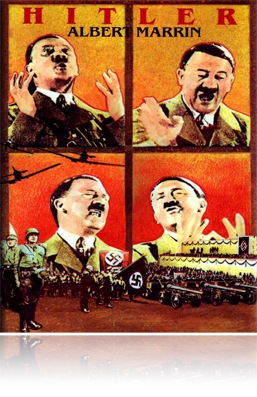
"Marrin writes insightfully about the life of Adolf Hitler and attempts to ascertain the reasons for his fanaticism, as well as the motives of those who blindly followed him. The author forgoes sensationalism, and his matter-of-fact writing style and recitation of events are more than adequate to chronicle the horror. Step-by-step, he describes how Hitler, a seemingly shy, insecure young man was able to inspire a defeated nation that saw the extermination of many of its citizens as it salvation." - Booklist
School Library Journal: Best Book of the Year

Adolf Hitler—der Fuehrer—rose from a childhood of obscurity to wield more power than probably any person in history. His control over his subjects was so complete that he literally shaped every aspect of their lives—the slightest defiance of his authority meant torture and death. Marrin carefully traces the forces that framed Hitler's fanaticism; readers will learn of his hardhearted and abusive father and his doting and indulgent mother who continually schooled Adolf in his superiority over other children. When he is twice rejected at a prestigious art school in Vienna, Hitler's delusional thoughts of himself seek a scapegoat for his seething anger. This was the genesis of Hitler's raging anti-Semitism that would play out in the deaths of over six million. Hitler's path to power included a heroic career as an infantryman in World War I where he earned six medals for bravery, including the Iron Cross. But Germany's surrender plunged him into a dark depression. In this state he began to believe he was called by God to "right Germany's wrongs, rebuild her armies, and punish the traitors." The rest is history, and Marrin brings the tragedy of Hitler's dark reign to the young adult reader in a manner that is honest, forthright and sobering. Illustrated with maps and photographs.


School Library Journal "Best Books of the Year"

When Joseph Djugashvili was born the son of a poor shoemaker, few suspected he would rise to become one of the twentieth century's most ruthless and powerful dictators. Enamored as a young man with the revolutionary politics of Lenin, he joined the underground Marxist Party and began his pursuit of power by leading strikes and demonstrations. Six times he was exiled to Siberia for his illicit activities, escaping many times despite below freezing temperatures and on one occasion an attack by a pack of wolves. His instinctive ability to command authority and divide the opposition through lies and deceit set him on a path he would follow to become Russia's most absolute dictator. He was never reticent to shed innocent blood in the pursuit of his own ends, and he carefully orchestrated demonstrations that brought about massacres that he then used to his own revolutionary ends. His vision was far reaching, and while his initial purpose was to establish a Soviet socialist state his larger goal was world domination. Ultimately responsible for the deaths of over 30 million—13 million alone in the Ukrainian famine he caused—Stalin's life is a sober and heartbreaking account of the reign of terror suffered by countless millions at the hands of one man. Illustrated with photographs.


Victory in the Pacific covers events from the surprise attack on Pearl Harbor through the battles of Midway, Guadalcanal, the Solomon Islands, Savo Island, the Doolittle raid on Tokyo, Corregidor Island, Leyte Gulf, Iwo Jima , and Okinawa. In each case, readers see the battles through the eyes of the men who were there, landing on the beaches, running raids in PT boats, dodging kamikaze bombers, and flying missions over Japan. In an easily accessible style, Marrin relates not only the important details of these conquests but also explains the military strategies of both the Allied forces and the Japanese. Readers get an overarching view of the war that helps to bring understanding especially as American forces drew increasingly closer to Japan and the Japanese grew ever more determined to fight to the bitter end. Marrin helps readers to understand the Japanese mindset that made surrender impossible and ultimately led to the decision to drop the atomic bomb in the interests of saving millions of lives. For the young adult reader, or even an adult unfamiliar with this period of WWII history, this book provides a sobering but inspiring look and the men and women , the nations and ideologies, that battled over half a century ago in the Pacific theater. Illustrated with diagrams, maps and photographs.


Portraying the sterling character of this admired hero, Marrin paints a complete picture of this complex man. Divided between his dislike of slavery and his loyalty to his beloved Virginia, Lee rose from an impoverished and tragic childhood to become one of the greatest military minds America has ever known even while being lauded for his kind, generous leadership. Marrin writes of Lee while including the stories of the ordinary soldiers, the Johnny Rebs and Billy Yanks. The victories, defeats, successes and failures of each side are portrayed in vivid and personal detail. Used in the Literature Approach to U.S. and World History, from the Civil War to Vietnam study guide.


All of the above titles are available on our website and we're offering a discount when you purchase more than one! Save $13.00 when you purchase all six in our Albert Marrin Collection, a Cathy Duffy Top 100 Pick for Homeschool award winner! Or save $9.00 when you purchase any four!

You can read reviews from other parents and readers at the links below:


And as a little bonus, you can watch Albert Marrin read from his book Flesh & Blood So Cheap, a finalist for the National Book Foundation Young Person's award. 


To learn more about Albert Marrin, visit his website.