Showing posts with label Charlotte Mason. Show all posts

Thursday, April 14, 2016

From the Archives: Making Time as a Family

It has been heartening to me to see a recent resurgence in the recognition that allowing children time to play is extremely important. Maybe it's a reaction to the Tiger Mom phenomenon. Maybe it's a recognition that it is possible to have too much of a good thing when it comes to extra-curricular activities. Maybe it's just a greater humility in parents who can recognize that their child will probably not be the next Steve Jobs or Yo-Yo Ma no matter how many classes and specialty camps she is enrolled in. Maybe its realizing that testing standards are by their nature arbitrary and result in classrooms where the natural learning processes are not only curbed but often destroyed. Maybe it's frustration with ever increasing homework loads. Whatever the cause may be, there is a growing movement that advocates for giving children time to play. Time to be kids. Time to get into scrapes and exercise their imagination.

I know we have talked about this before (if you missed these posts, check them out here and here and here) but today I want to take a different tack. The benefits of play have been well documented. There is even an article from The Atlantic extolling the benefits teaching your children to daydream. It's an excellent read and well worth your time.

But today I want to focus on an intangible that is difficult to measure. How would your home life change if you were to actively resist the compulsion to over-schedule? When I think about my own life and look back on my childhood, the times I most treasure were those in which life was less hectic. Now, I have to make allowances for the fact that I am an introvert in a family of extroverts, but I don't think any personality type enjoys the feeling of frenzied chaos. And yet, many of our homes feel like Grand Central Station, where we pass those we love the most in a rush, making our way to one meeting or co-op class or music lesson or sports tournament or church event. And yes, this is the nature of modern life. But, I wonder what we're sacrificing, especially in terms of our family life, with this constant on-the-go lifestyle. Is living this way conducive to being available for one another? Does it allow for time to ask your sulky 14-year-old why he's acting withdrawn instead of just telling him to "Snap out of it!"? Does it allow for spouses to connect in ways that ensure they still know one another when their nest is empty? Does it allow for setting aside time for spiritual investment and growth? Does it allow for you to take a break from worrying about academic achievement and just lay in the grass with your kids and watch the clouds go by? Does it allow you to be there for a friend in crisis?

Of course, every family has obligations and commitments and some are unavoidable. But is it possible to introduce a bit more play and time together into your family life? Homeschooling can prove to be a double-edged sword in this respect. There is the pressure of ensuring your children stay on track and are performing at grade level. There are more hours spent together but this can also be a bit crazy-making! So, how to balance the need to give your children time to play while ensuring they don't fall behind and you can maintain your sanity?

Incorporating play into schoolwork is a great place to start. One family that uses our curriculum does a wonderful job of creating fun projects based on books used in our study guides - like making Karana paper dolls during the unit on Island of the Blue Dolphins, or creating a board game based on Uncle Tom's Cabin. What fantastic ways to allow your children to play and create, all while learning more about history. Choosing curriculum that gives you the flexibility to chase down rabbit trails of creativity is key to ensuring your children do not get bogged down in drudgery. And that you all enjoy what you're learning together.

For families that have a difficult time setting aside family time and down time, it may be a good idea to actually schedule
it, like you would any other obligation. A well-rounded childhood will incorporate extracurricular activities. Sports, art lessons, musical training - these are all wonderful things to provide for your children and I don't want that to get lost in this discussion. Just make sure your children also have time to be with you. And this means time to just be with you - not doing anything obligatory. The gift of availability is one that cannot be overestimated in its importance to your children. Sometimes I hear from other parents who never consider the fact that their children do crave time with them. Don't make this same mistake. Your children want to be with you and the moments you are able to give them will have more of an impact on their lives and how they see themselves than any lesson or extracurricular activity. So celebrate that and try to keep it in mind when you're looking at that family calendar and trying to decide whether or not to add another activity.

Related Posts:


Don't forget to check out our Facebook and Pinterest pages. 
And if you've enjoyed this, please feel free to share using the buttons below!

Thursday, April 07, 2016

From the Archives: Brain Training with Jane Austen


We all know that exercise is good for your body. Now research confirms what we've known all along, reading is brain exercise! Neuroscientists and radiologists and humanities scholars have put together a fascinating interdisciplinary study to determine what happens to the brain when you read. It's always been assumed that reading helps develop the parts of your brain associated with executive function (decision making skills). What was surprising about this test, in which participants read sections of Jane Austen novels while laying in a MRI machine, is that blood flow increased not only to the executive function areas of the brain but also other areas showing that reading is good for the entire mind. Additionally, different areas lit up if the subject was reading closely or more casually  showing that both types of reading have value. So different areas benefit differently depending on whether the subject is paying close attention or simply reading for pleasure.

As one of the study authors stated: "it's not only what we read – but thinking rigorously about it that's of value, and that literary study provides a truly valuable exercise of people's brains." In an era when the focus on STEM (science, technology, engineering, and math) subjects are given (in my opinion) an outsized importance, it's good to see research that emphasizes the importance of reading. What makes this study so interesting is how it highlights the benefits of rigorous reading. This is important to keep in mind when our children and students complain about the difficulty of a book. Difficult reading becomes easier over time and this science shows why. So, encourage your students to press on in their reading of tougher titles. It's a discipline that will pay off in the long run. Of course, if your student is getting discouraged and wanting to quit reading entirely, peddle back and choose books that she enjoys to balance out the more difficult titles.

On a personal note, I remember being 11 or 12 years old and my mom assigning me Ivanhoe. This was the original. It's a tough read, especially for a youngster. And before the first chapter was over, I was in tears. It was ridiculously detailed (in my young expert opinion, ha!), the author used far too many fancy and long words and there was nothing enjoyable about spending 45 minutes reading
multiple pages that described a shepherd. I wanted to quit. But I was not allowed to and as I tearfully persevered it got easier. Soon I was looking forward to learning more about Rebekah, the Black Night and all the other colorful characters that dance through the pages of Sir Walter Scott's classic. Even now as an adult, if I've spent too much time away from the difficult classics, I know I have to push through the initial shock to my brain and that the reading will become less labored as my brain gets used to a more elevated style of writing.

To read more about the study, click here. And if you've experienced something like this, share below. Or if you have advice for encouraging young readers to tackle more difficult writing, chime in!

We would love to hear what you think! Chime in below in the comments section and share your thoughts. Don't forget to check out our Facebook and Pinterest pages.  To learn more about Beautiful Feet Books, click here.

And if you've enjoyed this, please feel free to share using the buttons below!

Thursday, March 31, 2016

From the Archives: 5 Ways to Empower your Reluctant Reader

5 Ways to Empower your Reluctant Reader

 The entries on this blog have focused on the importance of reading in education. Exposure to literature and the ideas contained therein is essential to the formation of a well-rounded individual. All of that is wonderful, but what if you have students who either dislike reading or have difficulty with it. ADHD, dyslexia, some forms of autism, and many other learning challenges can make reading a struggle. Others are simply not interested. What do you do in such cases? There are several practical ways to encourage and develop a love of reading.  


~Lead by Example~

Research backs up what any parent knows: children learn by example. Read in front of your children. Talk with others about the books you are reading. Parents who read for their own pleasure and communicate that experience by talking about the books they're reading are more likely to pique their children's interest.

~Build a Family Library~

Make books easily accessible. Begin building a family library. This will reinforce the value you place on reading. Make regular trips to the library so that there are new books in your home for your children to discover. Research shows that simply having books in the home predicts academic success.
~Prioritize Reading~

Make time for reading. Turning off the TV is one of the most important steps one can take in opening up space for reading. Limit time on the computer and playing video games. This may lead to boredom, not such a bad thing, and lead children to discovery reading for their own pleasure.

~Read Together~

Read aloud as a family. This is essential. While many children think of reading as "boring" everyone 
loves a good story. Read aloud some of your childhood favorites. Once children are introduced to the joys of hearing good stories, it is often not long until they are wanting to discover good books for themselves. Reading aloud is also essential for developing good writing skills, even more so than reading silently to oneself!

~Follow Their Lead~


Follow your children's interests. If your son dislikes reading but loves horses, read Marguerite Henry's lovely stories with him. Encourage your child's overactive imagination by introducing her to the wonderfully fantastical worlds of C. S. Lewis, Tolkien, Francis Hodgson Burnett, and Madeleine L'Engle. Show your children that books are one of the best ways to explore their interests.

Investigate the link between musical education and reading ability.

These are just a few practical suggestions and many people have found success in implementing some or all of these changes. If your child is still struggling, remember that all children develop at different speeds. We know children who took to reading immediately and for others it was slow process that took years. It may also be worth having your child tested for a learning disability. There are many tools and resources now available to help children with these challenges. Families have found help in therapeutic methods, teaching tools, even dietary changes! For a child who struggles with things that come easily to his friends or siblings, diagnosis can be a relief if it is presented in a supportive and encouraging manner.

I would love to hear from parents of reluctant readers! What have you done to encourage reading? How have you been successful? What challenges did you face?

We would love to hear what you think! Chime in below in the comments section and share your thoughts. Don't forget to check out our Facebook and Pinterest pages.  To learn more about Beautiful Feet Books, click here.

And if you've enjoyed this, please feel free to share using the buttons below!

Sunday, March 27, 2016

BFB Essentials: Why Teach History?

Over the next few days we will be reposting a series on BFB Essentials for anyone new to this blog and BFB. This will answer some very foundational questions for those of you who are looking into our approach to history including things like why teach history in the first place, who was Charlotte Mason, what is a Charlotte Mason approach, why use literature instead of textbooks, and much much more! We hope you find it helpful and enlightening.

BFB Essentials: Why Teach History? By Rebecca Berg Manor


Hello! We are excited to introduce a new series on our blog called BFB Essentials. We will be answering questions like "Why teach history?" and "Is BFB classical?" and "What's the point of using literature to teach history when textbooks make it so easy?" We hope you find it useful and would love to hear from you so feel free to email us with questions (rebecca@bfbooks.com) and comments. Feel free to share your experiences in the comments section. Let's get a conversation going! Without further ado, here we go!

Why Teach History?


For many who grew up and were educated in a traditional schoolroom setting the study of history may seem a bit pointless. How often have you been asked the date of the fall of Rome? Sure it was interesting to learn about the Pilgrims and the first Thanksgiving, but has that knowledge ever served you? And now you've decided to homeschool your children or are involved in teaching and history is a required subject. Or maybe your child is asking you, "Why do I need to know any of this anyway?" 

The fact that this question is now a common one points to an increasingly utilitarian view of education. In many ways the answer to the question of why to teach history comes down to one's educational philosophy. Is the purpose of education simply preparation for entering the workforce or is it something more? If you believe, as we do, that education goes beyond employee training, then like us, you probably believe in the importance of rich historical study. If you have a philosophy of education that includes training in critical thinking skills, reason, citizenship, and the formation of character, you probably have a great respect for the study of history. Unfortunately that educational philosophy, while ascribed to by many, is rarely held in conviction by educators and certainly not reflected in government mandates. Current statistics on student's knowledge of the basic facts of US history reveal a disturbing ignorance which belies any devotion to the study of history. Education is viewed as valuable in so far as it prepares young people to be good employees. And yes, education should prepare young people for adult lives, of which work is an important and valuable part, but it has a much deeper value in training young people to be compassionate, thoughtful, and engaged members of their communities. 


How did we get here? 


Over the past century the study of history has been increasingly isolated from the other disciplines. Beginning in the 19th century textbooks became the primary mode of teaching history. The drive towards standardization within classrooms drove the development of the textbook and it proved useful for subjects like math and science. Unfortunately for teaching a subject as vibrant as history, the adoption of textbooks stripped the subject of all its life. Where history was once the study of our human story and was filled with tales of adventure, heroic quests, stupefying failures, humorous dunces, and wicked villains, it became a collection of names and dates to be chanted over and over until they were firmly fixed in young minds. One can picture the one-room school houses with their strict schoolmarm, pointer in hand, drilling facts into the heads of students as they chant away the names of the presidents, dates of various battles, etc. Now, this approach, still employed by some educational approaches, is a great way to instill a knowledge of facts, but it's not so great for teaching students to engage with history, to form informed opinions, to discuss ideas. 

History as more than facts


From the beginning of time, we human beings have been storytellers. Long before people thought up the idea of "history" we were telling one another stories from the past, connecting our short lives with a long chain of others who came before us. Whether it was relating creation narratives or listing genealogies, whether it took place around a tribal circle or in the marble forums of ancient Greece, these stories were our first "histories". Often thought of as myths now, they provided ancient peoples with a context for the human story. Part of the human condition is the ability to question our place in this world and history provides part of the answer. In relating the human story and connecting ourselves with the vast pageant of people who came before us, we get to know ourselves a little better. We can see our lives within the context of something greater than ourselves. And history provides invaluable lessons in how to conduct ourselves. We can learn from the fascinating successes and failures of people who are not so different from us, but who lived in the centuries before us. This is the greater purpose of history–and it is lost when distilled down to basic names, dates, and "facts". 

But what about getting a job?


Now you may be thinking this is all great, but who is going to hire someone who isn't adequately prepared for a job? In our current economic climate the in vogue career paths are all about technology and medicine. Both of these career paths require specialized training and many education wonks are
advocating that we start teaching computer coding and advanced math in elementary school. This could be very short sighted. It is no longer a world where one can choose a career path and expect to work within that chosen field for the entirety of one's career. The average young person will change jobs/careers fifteen times in his or her lifetime. That's probably 12 times more than his parents and could be 14 times more than his grandparents. In a job market that is so fluid, the skills required are not necessarily highly specialized. Yes, it's a good idea to know how to write computer code, but it's more valuable to be able to think critically, to be creative and innovative, to understand human nature, make rational arguments, be an engaged reader, a thoughtful writer, and a thorough researcher. The study of history taught holistically provides these skills. And so you may find yourself asking, how do I teach history "properly"? That question will be answered in our next entry in this series. In the mean time, leave a comment below telling us about your experiences in learning and teaching history. 


We would love to hear what you think! Chime in below in the comments section and share your thoughts. Don't forget to check out our Facebook and Pinterest pages.  To learn more about Beautiful Feet Books, click here.
And if you've enjoyed this, please feel free to share using the buttons below! 

Friday, July 31, 2015

A Great Gift


Today Kathy shares some very practical tips for teaching youngsters how to read. As she says, it's one of the greatest gifts you can give your child!


"As a parent, I like to give my child gifts. The gift may be a simple gesture such as a hug or words of praise. Other times the gift is more elaborate. The longed for doll, which my daughter saved the money for, but the amount saved would not be enough to meet the ordering deadline. However, on Christmas morning, it was the last gift discovered behind the tree. I believe it is only natural that parents desire to give their child gifts. One of the greatest gifts you can give you child is the gift of “literacy” by teaching your child to read.

During the fall of 2001, our daughter began to “cue” my husband and I that reading aloud to her was not enough. She had been introduced to the printed word in infancy, was read to several times each day, had learned the Alphabet Song, and was speaking in full sentences by the time she was a year old. When she began to point to the words at the bottom of the page in her picture books, we took the hint and decided it was time to begin teaching her how to read. During my second grade year, I had taught my six year old cousin how to read. Subsequently, the following year, I had taught “remedial reading” skills to my nine year old cousin. So how hard could it be to teach my own child how to read?

I had recently read through Karen Andreola’s A Charlotte Mason Companion: Personal Reflections
on the Gentle Art of Learning which I began to peruse on this particular topic. “The first association children should make with each letter of the alphabet is with its sound, not its name.” (1) Based on what I had read, I made alphabet cards using 3x5 inch blank recipe cards and a red marker. I had read in Glen Doman’s book, How to Teach Your Baby to Read that young children visualize the letters better if they are written in the color red. The next step was the implementation of what Karen refers to as the “Three Period Lesson” in Ch. 20 of A Charlotte Mason Companion. The three-period lesson was developed by Edouard Seguin, a French physician who worked with special-needs children in France and the United States during the late 19th century. He discovered ways to increase children's cognitive abilities and believed in the importance of developing their self-reliance and independence. Seguin's writings were a major inspiration to Maria Montessori and the source of many of her practical ideas. (2) In comparing this concept with Charlotte’s teachings in Part V "Lessons as Instruments of Education" in her book Home Education, I found Seguin’s and Montessori’s approach coincided with Charlotte’s teachings.


“The Three Period Lesson” is a tool by which allows you to see your child’s knowledge of a particular concept. The lesson is divided into three parts: Naming (Introduction), Recognizing (Identification), Remembering (Cognition.) During Period One, I would show my daughter three alphabet cards which had a picture of the letters “A,” “B,” and “C,” on them. I would say to my daughter, “This letter makes the sound “a.” Say “a” with me. This letter makes the sound “bee.” Say “bee.” This letter makes the sound “see.” Say “see” with me. For Period Two I would place the three letter cards on our kitchen table in a mixed up order. I would call out, “Find the letter which makes the sound ‘a’.” “Find the letter which makes the sound ‘bee’.” Find the letter which makes the sound ‘see’.” In Period Three I would place the alphabet cards in the order of “A, B, C” in front of my daughter. I would then point to each letter individually and ask her, “What sound does this letter make?” Our daughter enjoyed the short, “Three Period Lesson” which became known as “The Alphabet Game.” I began this game with the vowels and progressed to consonants. Simultaneously, while spending time outdoors in the sandbox, I would draw a letter in the sand, take my daughters finger and help her trace the letter, while at the same time pronouncing the sound the letter makes and then naming the letter.

Once the sounds and letter names of the alphabet were learned, we moved on to learning sight words. As mentioned previously, I had written the names of sight words on blank 3x5 recipe cards in red marker. I followed the same outline as before for the “Three Period Lesson” to teach her sight words. After sight words were mastered, I began to construct sentences for our daughter to read. Sometimes the sentences would be simple, other times they would be silly and nonsensical.
So far, our adventure in learning to read was going well. However, I knew the next step would be to begin phonics instruction. After seriously perusing the library catalogue, I checked out three
phonics 
resources. The first resource was the popular phonics program which was laid out in the form of a game. After spending two hours a day for five days during my daughter’s naptime trying to figure the resource out, I put it to the side. The second resource I pulled out of the library bag was based on the concept of teaching your child to read the easy way. After reading through the first couple of lessons and attempting to decipher the complicated notation system, I put it to the side. The final resource I pulled from the library bag was Alpha-Phonics by Samuel L. Blumenfeld. The resource was simple, yet direct. Learning to recognize a letter by sound and sight is taught first, then the blending of letter sounds follows. Review sentences using the words taught provided extra reinforcement for the budding reader. During the next nine months, for ten to fifteen minutes each day, my daughter and I went through the lessons in Alpha-Phonics. By the time she reached her second birthday, our daughter was reading from the Dr. Seuss "I Can Read It All By Myself " Beginner Book Series. Through the years her taste in books has evolved from Fox in Socks, Madeline, Miss Rumphius, Judy Blume’s The Fudge Books, The Swiss Family Robinson to this summer’s selection of Gaston Leroux’s The Phantom of the Opera.
I truly believe the most important gift you as a parent can give your child is the “gift” of literacy. Teaching your child to read is easy. All it takes is commitment, dedication and perseverance from both the parent and child on a daily basis. I would like to leave you with a quote from Charlotte Mason which I have found to be a source of inspiration throughout the years. “A child has not begun his education until he has acquired the habit of reading to himself, with interest and pleasure, books fully on a level with his intelligence.” (3)
Bibliography

1. Andreola, Karen, A Charlotte Mason Companion: Personal Reflections on the Gentle Art of Learning, United States of America: Charlotte Mason Research and Supply, 1998.
2. Jane M. Jacobs, The Three-Period Lesson, Montessori Services.com, 2013
3. Mason, Charlotte, The Original Homeschooling Series Home Education , United States of America: Tyndale House, 1989.


Thank you so much Kathy! Anyone else have tips for teaching their children to read? Share below! 

Our new 2015-2016 catalog is now available! If you want to view it right now it's available online here. And if you would like to request a hardcopy, click here.

We would love to hear what you think! Chime in below in the comments section and share your thoughts. Don't forget to check out our Facebook and Pinterest pages.  To learn more about Beautiful Feet Books, click here.

And if you've enjoyed this, please feel free to share using the buttons below!

Thursday, June 11, 2015

How to choose the best books for your family

Today Kathy shares a follow-up to her great post, How to Raise a Reader, with advice on choosing the best books for your children.

     After sharing with my friend how my husband and I had raised a reader the next questions my friend asked were, “How do you select books for your child to read? Are there certain guidelines you follow?” As I shared with my friend, selecting books for your child to read is a skill a parent develops through time and experience. When we first began selecting books for our daughter, my husband and I found it helpful to keep a few basic guidelines in the back of our minds to help keep ourselves on track and traveling in the right direction.

~ Do you find the book interesting? ~ 

Great children’s literature has the ability to captivate adults, too. As C.S. Lewis once said, “A children's story that can only be enjoyed by children is not a good children's story in the slightest.”(1) Does the book contain a richness of literary language? Is the story compelling? Are there characters, actions, or lessons which will pierce the conscience and cleave to the soul?

~What will my child discover in this book? Can this book teach her about life? ~

As William Faulkner reminds us, a good book speaks to the reader about “the old verities and truths of the human heart, the old universal truths lacking which any story is ephemeral and doomed---love and honor and pity and pride and compassion and sacrifice.”

~ Has this book been read and enjoyed by generations of readers? ~ 

New books hit the bookstores and library shelves each year, and your child should have the opportunity to read them. However, your child should also spend time becoming acquainted with classic books. Time has a way of testing literature; weeding out the mediocre while preserving the best.

~ Is the book one you loved as a child? ~

As parents it is our responsibility to share our best loved books with our children. My husband’s Owls in the Family by Farley Mowat. Owls in the Family is the story of a boy named Billy and the adventures he shares with his two pet owls, Wol and Weeps. My husband loves this book because of its references to the natural world and the hilarious antics of Billy and his pet owls. My favorite book from childhood is Laura Ingalls Wilder’s Little House in the Big Woods. I loved this book because it is a daily account of life in a by gone era of American history. As an aspiring eight year old writer, I was drawn to the author’s conversational tone directed towards the reader.

William Wordsworth once wrote, “What we have loved, others will love, but we must teach them how.”

Selecting books for your child is a responsibility, but it is also a gift. One of the greatest gifts a parent can give to their child is introducing them to the wonderful world of the written word. In closing, I would like to leave you with one of my favorite quotes from author and illustrator, Howard Pyle which speaks on the importance of selecting good books for your child. “In one's mature years one forgets the books that one reads, but the stories of childhood leave an indelible impression, and their author always has a niche in the temple memory from which the image is never cast out to be thrown into the rubbish-heap of things that are outgrown and outlived."(2)

1. Bibliography: Bennett, William J. The Educated Child: A Parent’s Guide from Preschool through Eighth 
2. Grade, 1999, New York, New York, Simon and Schuster

Thank you for sharing such great guidelines Kathy! The summer is such a great time to explore new and old titles to give to your children. For some of our favorites check out our blog series on Read Aloud Favorites:

Books for Youngsters
Books for Middle Schoolers
Books for Jr. High Students
Books for High School Students

We are also offering some fun Summer Reading Packs on our website. Check them out!

This pack contains some of our favorite titles with stories of adventurous, strong girls! 

Share stories of courageous, generous, and loyal heroes to inspire your sons!

We would love to hear what you think! Chime in below in the comments section and share your thoughts. Don't forget to check out our Facebook and Pinterest pages.  To learn more about Beautiful Feet Books, click here.

And if you've enjoyed this, please feel free to share using the buttons below!

Tuesday, June 09, 2015

Education for Ideals or Jobs?


In today's culture of productivity and measured worth it can be difficult to grasp hold of the idea of education for its own sake. Amazingly this shift in values is a recent development! As recently as 1967, 86% of college freshmen said that "developing a meaningful philosophy of life" was an "essential or very important objective" of their college education. Only 40% said that "being very well off financially" was an essential goal. Today those numbers have flipped with 82% stating financial reasons are essential and only 45% citing more philosophical motivations. These numbers come from the American Freshman Survey which has been given to thousands of college freshmen for the past 50 years. Such a striking change in values is truly symptomatic of a broader cultural shift. The monetizing of value has reduced the benefit of seeking a good simply for its own sake. Stand this in contrast to the great thinkers of the past who saw worth in things that had little monetary value. Charlotte Mason stated “The question is not,—how much does the youth know? when he has finished his education—but how much does he care? And about how many orders of things does he care? In fact, how large is the room in which he finds his feet set? And, therefore, how full is the life he has before him?”

Educating children to be engaged in the great world we inhabit requires a focus on more than simply marketable competences, it requires the cultivation of character, imagination, empathy, and kindness. Yes, we want our children to have skills that will allow them to earn a wage, but education is so much more than that! This summer try to focus on cultivating their hearts - volunteer, take nature walks, draw, play, enjoy quiet afternoons of reading, plan playdates with friends, soak up time with loved ones; build up those skills that will open the world beyond the marketplace to the things and experiences that will give life true meaning.

We would love to hear what you think! Chime in below in the comments section and share your thoughts. Don't forget to check out our Facebook and Pinterest pages.  To learn more about Beautiful Feet Books, click here.

And if you've enjoyed this, please feel free to share using the buttons below!

Friday, May 15, 2015

Friday Wisdom


We would love to hear what you think! Chime in below in the comments section and share your thoughts. Don't forget to check out our Facebook and Pinterest pages.  To learn more about Beautiful Feet Books, click here.

And if you've enjoyed this, please feel free to share using the buttons below!

Friday, May 08, 2015

Friday Wisdom


We would love to hear what you think! Chime in below in the comments section and share your thoughts. Don't forget to check out our Facebook and Pinterest pages.  To learn more about Beautiful Feet Books, click here.

And if you've enjoyed this, please feel free to share using the buttons below!

Friday, May 01, 2015

Friday Wisdom


And we're running a special offer starting today! For those looking to get their school shopping done early, beginning tomorrow and going to the 15th we're offering Free Shipping on all orders over $50! Use coupon code "FREESHIP" upon checkout! See details here.

We would love to hear what you think! Chime in below in the comments section and share your thoughts. Don't forget to check out our Facebook and Pinterest pages.  To learn more about Beautiful Feet Books, click here.

And if you've enjoyed this, please feel free to share using the buttons below!

Friday, April 24, 2015

Charlotte Mason Wisdom


We would love to hear what you think! Chime in below in the comments section and share your thoughts. Don't forget to check out our Facebook and Pinterest pages.  To learn more about Beautiful Feet Books, click here.

And if you've enjoyed this, please feel free to share using the buttons below!


Tuesday, April 16, 2013

Product Feature: Early American and World History


"I really enjoyed this guide. I was able to work independently and I loved the Genevieve Foster books. Furthermore, I was able to incorporate the writing prompts into my writing program and the questions were well thought out. I would definitely recommend this to anybody." An 8th grade student's review
Our Early American and World History program is designed for students in 7-9th grade and features some of our favorite titles. Designed as a one-year study, students read books by award winning authors like Genevieve Foster, James Daugherty, Esther Forbes and Jean Lee Latham. The study guide features reading assignments, comprehension questions, vocabulary lists, report topics, an answer key, and much much more. Spanning a period from the 15th century to the US Civil War, students will learn about key events and people in American history as well as events like the French Revolution, the discovery of Japan, the exploration of Africa, and a world that was changing rapidly as explorers pushed the boundaries of the known world. Here are more detailed descriptions of each book featured in the Early American and World History study guide.

The World of Columbus and Sons by Genevive Foster is the story of a wonderful, changing, reawakening world—the world of the Renaissance and Reformation. Measured by the lifetime of Columbus and his sons, this book spans the years from 1451-1539. With Columbus as the central figure of this narrative, readers will also learn the fascinating stories of Prince Henry the Navigator, Ivan III of Russia, Gutenberg, Queen Isabella, Leonardo da Vinci, Mohammed II, the African ruler Nomi Mansa, Martin Luther, Erasmus, Albrecht Dürer, Copernicus, Michaelangelo and many others. Told in Foster's engaging and winsome style enhanced by her helpful chronologies and timelines, readers will learn of the religious, cultural and scientific changes that ushered in a new frontier of exploration and discovery.

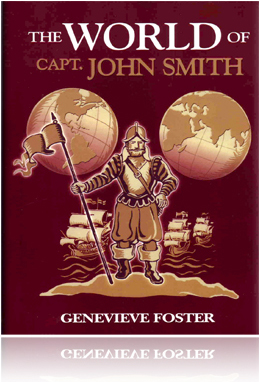
Next you will discover The World of Captain John Smith also by Genevieve Foster. Spanning the years from 1580-1631 the life of the adventurous John Smith gives a picture of the world just before and during the colonization of America. When Smith was a boy, Shakespeare was on his way to London to become an actor, the Spanish Armada had failed to conquer England, Mary Queen of Scots had lost her head, and Akbar the young prince of India sought to rule his people wisely. Galileo was perfecting his telescope and seeing things never before seen by the human eye, while Pocahontas romped the forests of Virginia and saved a young Englishman's life. A little band of Pilgrims seeking to escape religious persecution in England fled to Holland and a little Dutch boy named Rembrandt began to paint. These are just a few of the intriguing personalities, events, discoveries, and advances that made up the world of Captain John Smith and are now made alive to the reader in Foster's masterful way.

Next your student will explore the American colonies with several wonderful books including Poor Richard by James Daugherty. This lively text exemplifies both the man and the artist. Benjamin Franklin lived in turbulent times and met those times head-on with passion and gusto. James Daugherty—ever the patriot himself—has captured that essential nature of Franklin in his energetic and dramatic three-color lithographs that reveal the neophyte as he faces the fresh soil of a young nation filled with optimism and promise. From his Quaker childhood to his early days as printer's apprentice to runaway, to stranger in the City of Brotherly Love, to the "Water American" in London, Ben's youth was filled with adventures and challenges that taught him invaluable lessons about human nature. These lessons would serve him well as he grew to be a leader of the young colonies as they faced the tyranny of Britain. As a leader in the American Revolution he was indispensable as an ambassador to England and later France where he won the hearts of the nation by his simple Quaker wisdom and geniality. All these things were accomplished while he pursued his interests as scientist, inventor, and prolific author. In everything he did, Franklin was always compelled by how he might best serve his fellow man.

One of the best-selling American classics of all time is Johnny Tremain and your student is sure to enjoy the adventures of mischievous Johnny as he takes on the British redcoats. It's a story filled with danger and excitement, and the turbulent, passionate times in Boston just before the Revolutionary War. Johnny, a young apprentice silversmith, is caught up in a dramatic involvement with Otis, Hancock, and John and Samuel Adams in the exciting currents and undercurrents that were to lead to the Boston Tea Party and the Battle of Lexington–and finally, a touching resolution of Johnny's personal life.

The story of how the United States became an independent nation is vividly told in The Great Little Madison. Telling the story of the "Father of the Constitution", author Jean Fritz paints a vivid picture of this fascinating man as well as the government he played such a key role in establishing. Students will learn not only of the reasons why the colonies rebelled from England, but also how the founding fathers developed the US system of government. Fritz brings to life the vigorous debates in Independence Hall, the strong convictions, and the compromises. This book provides a wonderful introduction into government history and political theory for young readers.


George Washington's World provides more history of early America and it's struggles for independence and its formation as an independent country but it doesn't stop there. The period measured by the life of George Washington—1732 to 1799 —was one of revolution and change in many parts of the world as Enlightenment thinking took hold in the minds of men. When George was a young man, Benjamin Franklin was the most well-known American, Louis XV was on the throne of France, and George II was king of England. Father Junipero Serra had just arrived in Mexico to work with the Panes Indians. Mozart and Bach were writing their immortal music and Voltaire warred with his pen against Ignorance, Injustice and Superstition. The young nobleman Lafayette watched the feisty American colonies with fascinated interest as they stood up to Mother England when she sought to tax them unfairly. James Cook was sent by the Royal Society of London to Tahiti where their team of astronomers might observe a total eclipse of the sun and thereby accurately measure the distance between the earth and the sun. These are just a few of the wonderful narratives explored by Foster in her Newbery Honor Book of 1940. Prolifically illustrated with intriguing line drawings and detailed timelines, Foster's telling of the life story of George Washington does justice to the man it celebrates.

Back in the US, a young mathematician was going to revolutionize the world of navigation and your students will get to learn all about this fascinating young man in Carry On, Mr Bowditch. Readers today are still fascinated by "Nat," an eighteenth-century nautical wonder and mathematical wizard. Nathaniel Bowditch grew up in a sailor's world—Salem in the early days, when tall-masted ships from foreign ports crowded the wharves. But Nat didn't promise to have the makings of a sailor; he was too physically small. Nat may have been slight of build, but no one guessed that he had the persistence and determination to master sea navigation in the days when men sailed only by "log, lead, and lookout." Nat's long hours of study and observation, collected in his famous work, The American Practical Navigator (also known as the "Sailors' Bible"), stunned the sailing community and made him a New England hero.

The turn of a century sees much change in the young US as well as an unparalleled opportunity. Of Courage Undaunted by James Daugherty tells of the remarkable expedition of Meriwether Lewis and William Clark on their 3555-mile trek from St. Louis to the Pacific Ocean. Taken largely from original accounts of the expedition, Daugherty has written in his simple, forceful, and lyrical way to evoke the drama and pathos of what was one of American's most daring journeys of discovery. Commissioned in 1803 by President Thomas Jefferson to explore and open up this vast territory, Lewis and Clark felt it was the realization of a lifelong dream. Against the hardships of the wilderness, possible attack by hostile Indians, sudden blizzards and terrifying natural obstacles, these two men led a Corps of Discovery ably and nobly to complete their mission. Their Corps included American Indians from the Sioux, Mandan, Shoshone, Clatsop and Chopunnish tribes as well as one black slave named York. Sacajawea—the only woman on the trip—was a Shoshone who contributed invaluable service as interpreter and guide. Daugherty's evocative sepia and black ink illustrations depict individuals of humor, vitality, passion, and strength.

The course concludes with Abraham Lincoln's World in which Genevieve Foster once again relates the life of a great American and tells what was happening all around the world during his lifetime. Thus, while Abe Lincoln was a boy roaming the woods of Kentucky, Thomas Jefferson was completing his eighth year as president, George III reigned in Great Britain and Napolean was about to meet his Waterloo. Beethoven and Sir Walter Scott were at the height of their creative powers, while Victor Hugo was staging plays at school. By the time Lincoln was old enough to help his father chop wood, other young boys and girls were being prepared for the future parts they would play. Harriet Beecher was reading anything she could get her hands on, Charles Darwin was collecting toads, crabs and shells, and the impoverished boy Dickens was working in a shoe blacking factory in London. When Lincoln opened his shop in Salem, David Livingstone was opening up deepest Africa, and thousands of Americans were opening up the West on the Oregon Trail. The spirit of freedom was moving around the globe as the abolitionist movement gained power in the States and serfdom saw its demise in Russia. Technologically the world was bursting with the invention of the telegraph, the railroad and the steamboat. With her whimsical and informative illustrations and timelines Foster has magnificently captured a remarkable age and a remarkable man.

We hope this gives you a good idea of the wonderful reading adventures that are in-store for the student who chooses our Early American and World History study. Please let us know if you have any questions in the comments section! And if you've completed this study, let us know what you thought. 

Related Posts:


Don't forget to check out our Facebook and Pinterest pages. And if you've enjoyed this, please feel free to share using the buttons below!