Showing posts with label Charlotte Mason approach. Show all posts

Sunday, March 27, 2016

BFB Essentials: Why Teach History?

Over the next few days we will be reposting a series on BFB Essentials for anyone new to this blog and BFB. This will answer some very foundational questions for those of you who are looking into our approach to history including things like why teach history in the first place, who was Charlotte Mason, what is a Charlotte Mason approach, why use literature instead of textbooks, and much much more! We hope you find it helpful and enlightening.

BFB Essentials: Why Teach History? By Rebecca Berg Manor


Hello! We are excited to introduce a new series on our blog called BFB Essentials. We will be answering questions like "Why teach history?" and "Is BFB classical?" and "What's the point of using literature to teach history when textbooks make it so easy?" We hope you find it useful and would love to hear from you so feel free to email us with questions (rebecca@bfbooks.com) and comments. Feel free to share your experiences in the comments section. Let's get a conversation going! Without further ado, here we go!

Why Teach History?


For many who grew up and were educated in a traditional schoolroom setting the study of history may seem a bit pointless. How often have you been asked the date of the fall of Rome? Sure it was interesting to learn about the Pilgrims and the first Thanksgiving, but has that knowledge ever served you? And now you've decided to homeschool your children or are involved in teaching and history is a required subject. Or maybe your child is asking you, "Why do I need to know any of this anyway?" 

The fact that this question is now a common one points to an increasingly utilitarian view of education. In many ways the answer to the question of why to teach history comes down to one's educational philosophy. Is the purpose of education simply preparation for entering the workforce or is it something more? If you believe, as we do, that education goes beyond employee training, then like us, you probably believe in the importance of rich historical study. If you have a philosophy of education that includes training in critical thinking skills, reason, citizenship, and the formation of character, you probably have a great respect for the study of history. Unfortunately that educational philosophy, while ascribed to by many, is rarely held in conviction by educators and certainly not reflected in government mandates. Current statistics on student's knowledge of the basic facts of US history reveal a disturbing ignorance which belies any devotion to the study of history. Education is viewed as valuable in so far as it prepares young people to be good employees. And yes, education should prepare young people for adult lives, of which work is an important and valuable part, but it has a much deeper value in training young people to be compassionate, thoughtful, and engaged members of their communities. 


How did we get here? 


Over the past century the study of history has been increasingly isolated from the other disciplines. Beginning in the 19th century textbooks became the primary mode of teaching history. The drive towards standardization within classrooms drove the development of the textbook and it proved useful for subjects like math and science. Unfortunately for teaching a subject as vibrant as history, the adoption of textbooks stripped the subject of all its life. Where history was once the study of our human story and was filled with tales of adventure, heroic quests, stupefying failures, humorous dunces, and wicked villains, it became a collection of names and dates to be chanted over and over until they were firmly fixed in young minds. One can picture the one-room school houses with their strict schoolmarm, pointer in hand, drilling facts into the heads of students as they chant away the names of the presidents, dates of various battles, etc. Now, this approach, still employed by some educational approaches, is a great way to instill a knowledge of facts, but it's not so great for teaching students to engage with history, to form informed opinions, to discuss ideas. 

History as more than facts


From the beginning of time, we human beings have been storytellers. Long before people thought up the idea of "history" we were telling one another stories from the past, connecting our short lives with a long chain of others who came before us. Whether it was relating creation narratives or listing genealogies, whether it took place around a tribal circle or in the marble forums of ancient Greece, these stories were our first "histories". Often thought of as myths now, they provided ancient peoples with a context for the human story. Part of the human condition is the ability to question our place in this world and history provides part of the answer. In relating the human story and connecting ourselves with the vast pageant of people who came before us, we get to know ourselves a little better. We can see our lives within the context of something greater than ourselves. And history provides invaluable lessons in how to conduct ourselves. We can learn from the fascinating successes and failures of people who are not so different from us, but who lived in the centuries before us. This is the greater purpose of history–and it is lost when distilled down to basic names, dates, and "facts". 

But what about getting a job?


Now you may be thinking this is all great, but who is going to hire someone who isn't adequately prepared for a job? In our current economic climate the in vogue career paths are all about technology and medicine. Both of these career paths require specialized training and many education wonks are
advocating that we start teaching computer coding and advanced math in elementary school. This could be very short sighted. It is no longer a world where one can choose a career path and expect to work within that chosen field for the entirety of one's career. The average young person will change jobs/careers fifteen times in his or her lifetime. That's probably 12 times more than his parents and could be 14 times more than his grandparents. In a job market that is so fluid, the skills required are not necessarily highly specialized. Yes, it's a good idea to know how to write computer code, but it's more valuable to be able to think critically, to be creative and innovative, to understand human nature, make rational arguments, be an engaged reader, a thoughtful writer, and a thorough researcher. The study of history taught holistically provides these skills. And so you may find yourself asking, how do I teach history "properly"? That question will be answered in our next entry in this series. In the mean time, leave a comment below telling us about your experiences in learning and teaching history. 


We would love to hear what you think! Chime in below in the comments section and share your thoughts. Don't forget to check out our Facebook and Pinterest pages.  To learn more about Beautiful Feet Books, click here.
And if you've enjoyed this, please feel free to share using the buttons below! 

Tuesday, January 19, 2016

Fixed vs. Growth Mindset

Over the past couple of years I've been reading and hearing a lot about fixed versus growth mindsets and am fascinated by the topic. If this is the first time you've heard of this, I am so happy to be able to share the following 10 minute video from RSA Animate. It is the most straightforward introduction to the topic I have found and I think everyone (really!) can benefit from watching it:


Having grown up in the self-esteem boosting 1980s, my mindset was definitely influenced by praise that affirmed intelligence over effort and that worldview is definitely not something I want to pass on to my children. Therefore, I have been personally challenged by all my reading on the topic. Changing the language we use when praising the youngsters (and adults!) in our lives can be really challenging but I think that it is essential if we're going to help our kiddos become life-long learners. Of course, some people have cultivated a growth-mindset and some families are already great at encouraging effort and curiosity. In my interactions with thousands of families over the decades, I must say that I find growth-mindsets to be the exception rather than the rule. It is so easy to slip into praising naturally intelligent children for their smarts. Encouraging a child to work through a difficult math problem or diagraming a complex sentence takes a lot more time and patience. Even trying to get my two-year-old to not give up when his block towers fall over can be exacerbating. It's so much easier to just quickly build him another tower and restore his sunny spirits. Sitting out his tantrum, encouraging him to build the tower again, praising the fact that he hasn't given up, this takes more time. Yet, those 10-15 minutes of patience are more than rewarded when you see something "click" in his mind and he starts stacking those blocks, pride beaming in his face.

Children are all brilliant at seeing through empty praise. While trying to use growth-mindset language, it is important to not fall of the other side of the horse and praise every effort. Not all effort is praiseworthy and saying "Good try" at every turn will not encourage a child. Instead there should be an emphasis on future challenges. Angie Aker provides two great examples in her article on Upworthy:
FIXED MINDSET: "You finished that puzzle so quickly — what a smart kid!"GROWTH MINDSET: "I'm sorry I wasted your time with an easy puzzle — let me find another one that will give us a bigger challenge. I know we can do it!"FIXED MINDSET: "You got an 80% on your test." (And then moving on to the next chapter immediately.)GROWTH MINDSET: "You got an 80% on your test; that means you are well on your way to knowing this stuff! If you review the ones you missed and take the test again tomorrow, I bet you'll get closer to a 100%."
In choosing curriculum, I believe that it is important to look for programs that encourage this growth mindset. Charlotte Mason-style approaches naturally encourage inquisitiveness as does notebooking. When you get away from rigid standards that rely on simplistic answers and instead encourage reasoning, discussion, and the development of analytical skills, you will develop students who are much better equipped to succeed.

I would love to hear from you! Have you heard the terms growth mindset and fixed mindset? Have you implemented some of these practices in your homeschool? Did you grow up in an environment that encouraged the development of one type of mindset over another? Comment below!

We would love to hear what you think! Chime in below in the comments section and share your thoughts. Don't forget to check out our Facebook and Pinterest pages.  To learn more about Beautiful Feet Books, click here.

And if you've enjoyed this, please feel free to share using the buttons below!

Friday, May 08, 2015

Friday Wisdom


We would love to hear what you think! Chime in below in the comments section and share your thoughts. Don't forget to check out our Facebook and Pinterest pages.  To learn more about Beautiful Feet Books, click here.

And if you've enjoyed this, please feel free to share using the buttons below!

Friday, May 01, 2015

Friday Wisdom


And we're running a special offer starting today! For those looking to get their school shopping done early, beginning tomorrow and going to the 15th we're offering Free Shipping on all orders over $50! Use coupon code "FREESHIP" upon checkout! See details here.

We would love to hear what you think! Chime in below in the comments section and share your thoughts. Don't forget to check out our Facebook and Pinterest pages.  To learn more about Beautiful Feet Books, click here.

And if you've enjoyed this, please feel free to share using the buttons below!

Friday, April 24, 2015

Charlotte Mason Wisdom


We would love to hear what you think! Chime in below in the comments section and share your thoughts. Don't forget to check out our Facebook and Pinterest pages.  To learn more about Beautiful Feet Books, click here.

And if you've enjoyed this, please feel free to share using the buttons below!


Tuesday, April 16, 2013

Product Feature: Early American and World History


"I really enjoyed this guide. I was able to work independently and I loved the Genevieve Foster books. Furthermore, I was able to incorporate the writing prompts into my writing program and the questions were well thought out. I would definitely recommend this to anybody." An 8th grade student's review
Our Early American and World History program is designed for students in 7-9th grade and features some of our favorite titles. Designed as a one-year study, students read books by award winning authors like Genevieve Foster, James Daugherty, Esther Forbes and Jean Lee Latham. The study guide features reading assignments, comprehension questions, vocabulary lists, report topics, an answer key, and much much more. Spanning a period from the 15th century to the US Civil War, students will learn about key events and people in American history as well as events like the French Revolution, the discovery of Japan, the exploration of Africa, and a world that was changing rapidly as explorers pushed the boundaries of the known world. Here are more detailed descriptions of each book featured in the Early American and World History study guide.

The World of Columbus and Sons by Genevive Foster is the story of a wonderful, changing, reawakening world—the world of the Renaissance and Reformation. Measured by the lifetime of Columbus and his sons, this book spans the years from 1451-1539. With Columbus as the central figure of this narrative, readers will also learn the fascinating stories of Prince Henry the Navigator, Ivan III of Russia, Gutenberg, Queen Isabella, Leonardo da Vinci, Mohammed II, the African ruler Nomi Mansa, Martin Luther, Erasmus, Albrecht Dürer, Copernicus, Michaelangelo and many others. Told in Foster's engaging and winsome style enhanced by her helpful chronologies and timelines, readers will learn of the religious, cultural and scientific changes that ushered in a new frontier of exploration and discovery.

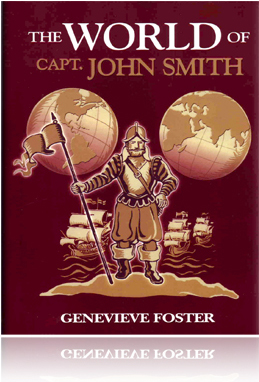
Next you will discover The World of Captain John Smith also by Genevieve Foster. Spanning the years from 1580-1631 the life of the adventurous John Smith gives a picture of the world just before and during the colonization of America. When Smith was a boy, Shakespeare was on his way to London to become an actor, the Spanish Armada had failed to conquer England, Mary Queen of Scots had lost her head, and Akbar the young prince of India sought to rule his people wisely. Galileo was perfecting his telescope and seeing things never before seen by the human eye, while Pocahontas romped the forests of Virginia and saved a young Englishman's life. A little band of Pilgrims seeking to escape religious persecution in England fled to Holland and a little Dutch boy named Rembrandt began to paint. These are just a few of the intriguing personalities, events, discoveries, and advances that made up the world of Captain John Smith and are now made alive to the reader in Foster's masterful way.

Next your student will explore the American colonies with several wonderful books including Poor Richard by James Daugherty. This lively text exemplifies both the man and the artist. Benjamin Franklin lived in turbulent times and met those times head-on with passion and gusto. James Daugherty—ever the patriot himself—has captured that essential nature of Franklin in his energetic and dramatic three-color lithographs that reveal the neophyte as he faces the fresh soil of a young nation filled with optimism and promise. From his Quaker childhood to his early days as printer's apprentice to runaway, to stranger in the City of Brotherly Love, to the "Water American" in London, Ben's youth was filled with adventures and challenges that taught him invaluable lessons about human nature. These lessons would serve him well as he grew to be a leader of the young colonies as they faced the tyranny of Britain. As a leader in the American Revolution he was indispensable as an ambassador to England and later France where he won the hearts of the nation by his simple Quaker wisdom and geniality. All these things were accomplished while he pursued his interests as scientist, inventor, and prolific author. In everything he did, Franklin was always compelled by how he might best serve his fellow man.

One of the best-selling American classics of all time is Johnny Tremain and your student is sure to enjoy the adventures of mischievous Johnny as he takes on the British redcoats. It's a story filled with danger and excitement, and the turbulent, passionate times in Boston just before the Revolutionary War. Johnny, a young apprentice silversmith, is caught up in a dramatic involvement with Otis, Hancock, and John and Samuel Adams in the exciting currents and undercurrents that were to lead to the Boston Tea Party and the Battle of Lexington–and finally, a touching resolution of Johnny's personal life.

The story of how the United States became an independent nation is vividly told in The Great Little Madison. Telling the story of the "Father of the Constitution", author Jean Fritz paints a vivid picture of this fascinating man as well as the government he played such a key role in establishing. Students will learn not only of the reasons why the colonies rebelled from England, but also how the founding fathers developed the US system of government. Fritz brings to life the vigorous debates in Independence Hall, the strong convictions, and the compromises. This book provides a wonderful introduction into government history and political theory for young readers.


George Washington's World provides more history of early America and it's struggles for independence and its formation as an independent country but it doesn't stop there. The period measured by the life of George Washington—1732 to 1799 —was one of revolution and change in many parts of the world as Enlightenment thinking took hold in the minds of men. When George was a young man, Benjamin Franklin was the most well-known American, Louis XV was on the throne of France, and George II was king of England. Father Junipero Serra had just arrived in Mexico to work with the Panes Indians. Mozart and Bach were writing their immortal music and Voltaire warred with his pen against Ignorance, Injustice and Superstition. The young nobleman Lafayette watched the feisty American colonies with fascinated interest as they stood up to Mother England when she sought to tax them unfairly. James Cook was sent by the Royal Society of London to Tahiti where their team of astronomers might observe a total eclipse of the sun and thereby accurately measure the distance between the earth and the sun. These are just a few of the wonderful narratives explored by Foster in her Newbery Honor Book of 1940. Prolifically illustrated with intriguing line drawings and detailed timelines, Foster's telling of the life story of George Washington does justice to the man it celebrates.

Back in the US, a young mathematician was going to revolutionize the world of navigation and your students will get to learn all about this fascinating young man in Carry On, Mr Bowditch. Readers today are still fascinated by "Nat," an eighteenth-century nautical wonder and mathematical wizard. Nathaniel Bowditch grew up in a sailor's world—Salem in the early days, when tall-masted ships from foreign ports crowded the wharves. But Nat didn't promise to have the makings of a sailor; he was too physically small. Nat may have been slight of build, but no one guessed that he had the persistence and determination to master sea navigation in the days when men sailed only by "log, lead, and lookout." Nat's long hours of study and observation, collected in his famous work, The American Practical Navigator (also known as the "Sailors' Bible"), stunned the sailing community and made him a New England hero.

The turn of a century sees much change in the young US as well as an unparalleled opportunity. Of Courage Undaunted by James Daugherty tells of the remarkable expedition of Meriwether Lewis and William Clark on their 3555-mile trek from St. Louis to the Pacific Ocean. Taken largely from original accounts of the expedition, Daugherty has written in his simple, forceful, and lyrical way to evoke the drama and pathos of what was one of American's most daring journeys of discovery. Commissioned in 1803 by President Thomas Jefferson to explore and open up this vast territory, Lewis and Clark felt it was the realization of a lifelong dream. Against the hardships of the wilderness, possible attack by hostile Indians, sudden blizzards and terrifying natural obstacles, these two men led a Corps of Discovery ably and nobly to complete their mission. Their Corps included American Indians from the Sioux, Mandan, Shoshone, Clatsop and Chopunnish tribes as well as one black slave named York. Sacajawea—the only woman on the trip—was a Shoshone who contributed invaluable service as interpreter and guide. Daugherty's evocative sepia and black ink illustrations depict individuals of humor, vitality, passion, and strength.

The course concludes with Abraham Lincoln's World in which Genevieve Foster once again relates the life of a great American and tells what was happening all around the world during his lifetime. Thus, while Abe Lincoln was a boy roaming the woods of Kentucky, Thomas Jefferson was completing his eighth year as president, George III reigned in Great Britain and Napolean was about to meet his Waterloo. Beethoven and Sir Walter Scott were at the height of their creative powers, while Victor Hugo was staging plays at school. By the time Lincoln was old enough to help his father chop wood, other young boys and girls were being prepared for the future parts they would play. Harriet Beecher was reading anything she could get her hands on, Charles Darwin was collecting toads, crabs and shells, and the impoverished boy Dickens was working in a shoe blacking factory in London. When Lincoln opened his shop in Salem, David Livingstone was opening up deepest Africa, and thousands of Americans were opening up the West on the Oregon Trail. The spirit of freedom was moving around the globe as the abolitionist movement gained power in the States and serfdom saw its demise in Russia. Technologically the world was bursting with the invention of the telegraph, the railroad and the steamboat. With her whimsical and informative illustrations and timelines Foster has magnificently captured a remarkable age and a remarkable man.

We hope this gives you a good idea of the wonderful reading adventures that are in-store for the student who chooses our Early American and World History study. Please let us know if you have any questions in the comments section! And if you've completed this study, let us know what you thought. 

Related Posts:


Don't forget to check out our Facebook and Pinterest pages. And if you've enjoyed this, please feel free to share using the buttons below!

Thursday, March 21, 2013

A Child's First Book of American History


We are pleased to announce that A Child's First Book of American History is at the printers! We know many of you have been waiting for a long time and after a year-long process, it's going to be arriving soon. When we first undertook the project of bringing this book back into print we had no idea what we were getting ourselves into! Rea has been working on this book for over a year, tweaking color adjustments, redoing the entire text layout, and dozen other things. 

And now for a sneak peak into this beautiful book. Click on any picture to enlarge. 


This is America! and this is its glowing, epic story, from the days of the Viking expeditions to the birth of the Atomic Age. Here are the explorers, the Indians, the settlers and fur trappers, the soldiers, the statesmen, the men and women who have shaped our country and its destiny. It is a continuous tale of adventure, of wars, of industry and invention, of hardship and growth; it is an unparalleled tale of courage, high ideas, hard work–and a precious thing called Freedom.

Perhaps more happened, faster, in the history of this country than in any other. Earl Schenck Miers tells its story as it should be told: in terms of the great moments and events, and through the lives and experiences of individuals.

Among the fifty chapters: the faith and longing for freedom of worship that brought the band of Pilgrims to Plymouth's shores, James Smith's own account of his capture by the Indians in 1755, excerpts from Davy Crockett's diary telling of the last days of the Alamo, a young Southern girl's description of the burning of Columbia, South Carolina in the Civil War, the story of the transcontinental railroad, and much much more. Miers has unforgettably recreated the hardships of a cattle drive, the the inspiring story of Booker T. Washington's fight to overcome great obstacles, the suspense that held America under its spell in 1927 when a young man named Lindbergh flew to Paris all by himself.


This telling of the American story is dramatic, ever engrossing–and it is based on careful scholarship. The more than 200 illustrations by James Daugherty–most of them in color–are an integral part of the book. A great artist and a superb scholar-storyteller have joined forces to produce a memorable record–an instructive, immensely readable and heart-warming book about the country we love.

About the Author: 

Earl Schenck Miers was an American historian (1910-1972), who wrote over 100 books, mostly about the Civil War. In the words of another notable historian–Paul Angle, Miers was one "who stressed the essential drama of events and brought the human beings of the past back to life." Despite struggling with cerebral palsy from birth, which made even holding a pen or pencil nearly impossible, Miers began writing as a youth, by carrying a typewriter to school each day. He attended Rutgers University where he studied journalism and founded the Rutgers University Press. Some of his more popular children's works include the We Were There series published by Grosset & Dunlap. 

About the Illustrator:

James Daugherty, an illustrator and author (1889-1974), was passionate about the American story and believed it ought to be told through vigorous illustration and spirited text.He is best known for his folksy all-American retelling of the fable of Androcles, in Andy and the Lion, which earned the author/illustrator the Caldecott Honor Medal in 1938. In Carl Sandburg's Abe Lincoln Grows Up, a perfect marriage blended Sandburg's lyrical prose with Daugherty's tender yet powerful sketches of Abe as he grows from a boy to a young man. In The Magna Charta, Daugherty tells the often humorous, yet inspiring story of one of Western civilization's most significant milestones in the progress of civil liberty–the signing of the Magna Charta by King John at Runnymede in 1215. Of Courage Undaunted brings Daugherty's manly illustrations to full flower in the adventure of Lewis and Clark's remarkable exploration of the Louisiana Purchase. Poor Richard captures the essential nature of Benjamin Franklin with energetic and dramatic three-color lithographs that reveal the witty and ever-genial printer, inventor, statesman, diplomat, and brilliant Founder. Beautiful Feet Books is honored to be providing a number of Daugherty's works to a new generation of young Americans.


If you've enjoyed this, please share it! You can do so using the buttons below. And don't forget to check out our Facebook and Pinterest pages.

Friday, December 21, 2012

Update from Samantha!


Today we have a special treat for you! Samantha is back and is sharing her thoughts from her first semester of using BFB. If you missed Samantha's first post, you can read it here. And here's Sam:

Let me start by saying, I love history.  This is a new development for me.  Social Studies, as it was called when I was in school, was always so boring.  It seems like so many facts and dates I had to memorize about boring dead people.  But now as we have been studying Early American History this past fall, we have found it is full of amazing people, far from dead, who struggled and failed and triumphed in their quest for a better life for themselves and their children.  As a mother I can relate to this.  I had a well-to-do upbringing with my parents still married.  I went to a private school and had the opportunity to go on to college.  But education is so much more than just the degree after the work.  It should be about the journey, and this is the “better life” I want for my children: to fall in love with the learning process, to know the joy of a job well done, and to develop the character of perseverance when working on hard subjects.
This is our third year homeschooling.  In the first two years, kindergarten and first grade, we focused on what I felt were the essentials: reading, writing and math.  We also did a national classical program that included memory work.  I really felt that if we could get a great foundation of reading under our belts, everything else would come easier. So this year I decided to branch out and do history and other subjects.  I was so grateful to come across Rea at the Great Homeschool Convention in California this past summer.  As my boys (twin 7 year-olds and a 3 year-old) loved the group setting we had, and as I am the “starter” among my group of friends, I decided to start a group.  Here is what we have done:
  • We decided to start with the Early American History pack, primary edition.  The kids involved are from 3 years old to 8.  The 3 and 4 year olds spend half the time with Playdoh, but they do spend half of the time with the group.  We did two lessons together in class, and then everyone did one at home on their own.  We wanted to get to Pilgrim Stories by Thanksgiving.
  • As I told my friends about this group there were many that wanted to join us.  We had 11 in the beginning.  For scheduling reasons, we are now down to 9, which include my 3 year old and a 4 year old.  This size group really is perfect.  At 11 kids, it was a bit more to manage.  The kids who also stopped coming were younger, in kindergarten. I think this pack would still be great for kindergarteners, but the level the rest of the kids were working at, the majority being 2nd and 3rd graders, made them feel a bit behind.  It may also be my lack of experience in working with a multi-age group.  It might just take someone who is more experienced with an age gap. 
  • When we started, we also wanted to do a bit of music and art.  I had read For the Children’s Sake by Susan Schafer Macauley and wanted to do it the way she described. 
  •  For art, I went to the Getty and tried to find one specific artist, got copies of four of his works and then had the kids narrate the art for me.  Then we did reproductions of the work in different mediums.  Then we would go back and visit the museum and the kids would have an instant connection to the artwork.  The artist I picked was Anthony Van Dyck.  The works I picked I think were a bit too advanced for these kids and they struggled with reproducing them, but they did enjoy narrating them.  So we kept  that portion and I let the two artistic children in the group draw them for me after everyone else was done. 
  • For music, the initial idea was to have the kids color while listening to the Music Masters CDs.  I think the problem we encountered with this, as this was the last thing we did, was the kids couldn’t sit still anymore and wanted to play with their friends.  I also think we needed to spend more time on each composer.  One week was just not enough time.  The last couple of weeks of class we decided to study Beethoven.  So they all listed to the Music Masters CD, colored pages, and we watched a movie called “Beethoven Lives Upstairs”. 
So here are some highlights from the year.

  • Leif the Lucky – We loved studying Leif Erickson.  The sense of adventure and courage that Leif seemed to embody really came across to the boys.  And then to see him believe as a Christian and want to bring the faith back to his people was part of that adventure.  Of course the illustrations were amazing and the writing was done so beautifully that it captured and kept their attention easily. 

  • Columbus – Again, we loved studying Columbus.  The book was wonderful and so beautifully done.  You can’t praise the D’Aulaire’s enough for all their beautiful books, the wonderful writing and the amazing detailed pictures.  We loved the Your Story Hour CD’s and the expansion of Columbus’ story.  Each child prepared an amazing oral presentation of the book.  Some were more detailed than others.  But all seemed to have a very full experience of who Columbus was and the type of man he was.  It was so much more than “in 1492, Columbus sailed the ocean blue”.  I loved how they all got that he had to wait for his adventure, how he was turned down by Portugal, and even after he ventured to the Americas, things did not always go well.  It was definitely not a fairy tale version. 
  •  Pocahontas– Since I have 7 year old boys, I was wondering how I was going to sell the whole Indian princess thing to them.  But as it turned out, this was their favorite book.  In these lessons, they visited the library and learned more about John Smith, which was really neat for them.  I almost would say, they thought the whole Pocahontas lessons were more about John Smith.  What an amazing character to study.  Here was a man with many talents and abilities.  His natural drive and sense of adventure led him all over the world as it was known then, and elevated him in the ranks of foreign military.  It is believed that if Jamestown had any success, it was due to his leadership.  But because of his harsh nature, he was hindered.  It wasn’t actually known if the injury he sustained to his leg was by accident or was a failed attempt on his life.  It was a great study for my growing boys to see how the undeveloped portions of a man’s character can hold him back from becoming all that he can be. 
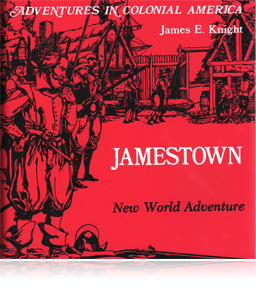
  •  Jamestown, New World Adventure – This was a great book to read. I loved how all the children were able to connect to the children in the story...   It was a good portrayal of how hard life was for these early settlers.  It again chronicled how hard John Smith was to the people.  But at times it seemed he needed to be stern with the gentlemen who didn’t want to do their share of the work. 
  • Pilgrim Stories – As I write this, we are only halfway thru this book.  Our group only met thru November.  We would have met thru the middle of December, but my family moved and we needed to take some time off to get re-settled.  But I will say, I was shocked to find out the Pilgrims did not come straight to America from England, but first escaped to Holland.  It’s realizations like this that have me further convinced of my own poor education.  The boys think the names of the children in the book are funny, Patience, Fear and Faith.  But I remind them that I am sure those children would think their names equally strange.  It has been interesting to watch them wrestle through the idea that both the pilgrims and King James were all “Christians” yet they did not worship the same or believe the same.  It is a foreign idea to them to not be able to worship God the way you want and need to escape to another land to do so.  The descriptions of Holland have been so interesting that I have been wanting to do more study on this distant  country.  The mental picture of the frozen canals and the boats on runners is fascinating.  And the boys love the idea of a little boy walking by a dike and seeing a small leak, and the boy putting his chewing gum in the hole to save the town.  We are now just leaving England on the Mayflower and can’t wait for the rest of the book. 

I can’t wait to share more with you all on our adventure thru history in the coming.

Thank you Samantha! It's such a joy to read about your adventures. If anyone has any questions about the books mentioned in this post, feel free to leave a comment below and we will get right back to you.

You may also enjoy:


Also, just as a reminder, we're offering Free Shipping on all orders over $25.00. Special ends December 21. Simply use the code "FREESHIP" in the coupon code box at checkout.  


Don't forget to check out our Facebook and Pinterest pages. And if you've enjoyed this, please feel free to share using the buttons below!