Showing posts with label Product Feature. Show all posts

Wednesday, April 24, 2013

Product Feature: US and World History Parts I & II

Our US and World History program is designed for high school students wanting an in-depth study of US and World history from the Civil War through the Vietnam War. It features some of our favorite books like To Kill a Mockingbird as well as three titles by Albert Marrin. The course has four parts, one for each semester of two years. Today we will feature the literature for the first year. The study includes a multitude of essential events, political figures, inventions, technological advances, social climates, and movements are all examined with study notes, comprehensive questions, vocabulary, and essay questions encouraging the mature student to evaluate and determine the lessons of history. Rea's most extensive guide, our award-winning U.S. and World History Study Guide (92 pages) also includes detailed teacher's notes for the essential literature used in the course. The study guide is divided into four sections and it is suggested that one section be completed each semester, resulting in a two-year study. Students will delight in the fine, award-winning literature of such masters as Harper Lee, Stephen Crane, Harriet Beecher Stowe, Irene Hunt, Meindert Dejong, Harold Keith, Albert Marrin and others. Web sites, recommended movies, and original source materials are also suggested. Three History of US titles by Joy Hakim are used in the study as background texts or used to fill in for the lack of literature. Highly recommended for the 'I love to read', inquisitive student! Below are the books featured in the study.


Part I (or Semester I)


Uncle Tom's Cabin brought the evils of slavery to the consciences and hearts of the American people by its moving portrayal of slave experience. Harriet Beecher Stowe shows us in scenes of great dramatic power the human effects of an economic system in which slaves were property: the break up of families, the struggles for freedom, the horrors of plantation labor. She brings into fiction the different voices of the emerging American nation, the Southern slave-owning classes, Northern abolitionists, children, the sorrow songs and dialect of slaves, as well the language of political debate and religious zeal. The novel was, and is, controversial, abrasive in its demand for change, yet also brilliant in the deployment of dialogue, with great comic skill and a power of pathos that made it a runaway bestseller in its time that continues to move us today. A classic that should not be missed in a study of the Civil War. Though language at times is difficult, we have read it aloud with great success to ages from 8-15.

Harriet Beecher Stowe and the Beecher Preachers Harriet Beecher Stowe opposed slavery with a passion, but she was a housewife with six children. What could she do? "You can write," her sister-in-law said. So she did. In 1852 her novel Uncle Tom's Cabin was published, and Harriet became an instant celebrity. This shouldn't have been surprising. Harriet was a Beecher, and all the Beechers made names for themselves. Her father, Lyman Beecher, was the most renowned preacher in America, but he didn't expect much from his girls. He was collecting boys because he wanted a lot of preachers in the family. He ended up with seven preachers in the family, but in her own way Harriet was the best of the lot. She became famous not just at home but all over Europe as well. When she traveled to England, crowds gathered in the streets just to see her, and thousands attended her public meetings. President Lincoln called her "the little lady who made this big war." What was she like, this nineteenth-century daughter, wife, and mother who said, "Writing is my element" and "I have determined not to be a mere domestic slave"? Award-winning biographer Jean Fritz brings this remarkable woman and her extraordinary family to life.


Across Five Aprils The unforgettable story of young Jethro Creighton, who comes of age during the turbulent years of the Civil War, by the Newbery Award-winning author Irene Hunt. Poignant, heartwarming, and heart-breaking story of an Illinois farm family and their saga during the Civil War. Insightful look at how war affects even the closest families. Well-researched and highly recommended. "An impressive book both as a historically authentic Civil War novel and as a beautifully written family story." -University of Chicago Center for Children's Books


Rifles for Watie In the Indian country south of Kansas there was dread in the air;
and the name, Stand Watie, was on every tongue. A hero to the rebel, a devil to the Union man, Stand Watie led the Cherokee Indian Nation fearlessly and successfully on savage raids behind the Union lines. Jeff came to know the Watie men only too well. He was probably the only soldier in the West to see the Civil War from both sides and live to tell about it. Amid the roar of cannon and the swish of flying grape, Jeff learned what it meant to fight in battle. This is a rich and sweeping novel-rich in its panorama of history; in its details so clear that the reader never doubts for a moment that he is there; in its dozens of different people, each one fully realized and wholly recognizable. It is a story of a lesser-known part of the Civil War, the Western campaign, a part different in its issues and its problems, and fought with a different savagery. Inexorably it moves to a dramatic climax, evoking a brilliant picture of a war and the men of both sides who fought in it. This Newbery Medal winner is a book that will really appeal to boys who have an interest in the Civil War drama. The story of a young Union recruit who is given opportunity to see the war from both sides, and must make some difficult choices in the process.


The Red Badge of Courage Published thirty years after the Civil War, this "impressionistic" American classic tells a war story in a thoroughly modern way - without a trace of romanticizing. Through the eyes of ordinary soldier Henry Fleming, we follow his psychological turmoil, from the excitement of patriotism to the bloody realities of battle and his flight from it. In the end, he overcomes his fear and disillusionment, and fights with courage. The first great 'modern' novel of war by an American. 


Sojourner Truth, Ain't I a Woman? In 1797, a slave named Isabella was born in New York. After being freed in 1827, she chose the name by which she has been remembered long after her death - Sojourner Truth.Truth was a preacher, an abolitionist, an activist for the rights of both blacks and women. Although she couldn't read, she could quote the Bible word for word, and was a powerful speaker. An imposing six feet tall, with a profound faith in God's love and a deep rich voice, she stirred audiences around the country until her death in 1883. Read about her profound faith in God's love and the fruit that it bore!


Virginia's General: Robert E. Lee and the Civil War Portraying the sterling character of this admired hero, Marrin paints a complete picture of this complex man. Divided between his dislike of slavery and his loyalty to his beloved Virginia, Lee rose from an impoverished and tragic childhood to become one of the greatest military minds America has ever known even while being lauded for his kind, generous leadership. Marrin writes of Lee while including the stories of the ordinary soldiers, the Johnny Rebs and Billy Yanks. The victories, defeats, successes and failures of each side are portrayed in vivid and personal detail.


Reconstruction, Binding the Wounds A collection of first person accounts and secondary sources of the rebuilding the nation following the devastation of the Civil War. Focuses on the civil, social and economic problems of the day concerning the freed slaves, carpetbaggers, government policy, KKK, Lincoln's Ten Percent Plan and more. Includes personal diary entries, newspaper clippings, photographs, and much more.


Up from Slavery by Booker T. Washington, 'He lifted the veil of ignorance from his people and pointed the way to progress through education and industry.' Booker T. Washington's devotion to the virtues of godliness, honesty, thrift, perseverance, cleanliness and hard work left a honorable legacy that's inspired many. This is part of American history, that all students should know.


Around the World in Eighty Days A fastidious English gentleman makes a remarkable wager - he will travel around the world in eighty days or forfeit his life's savings. Thus begins Jules Verne's classic 1872 novel, which remains unsurpassed in sheer story-telling entertainment and pure adventure. Phileas Fogg and his faithful manservant, Jean Passepartout, embark on a fantastic journey into a world filled with danger and beauty - from the exotic shores of India, where the heroic travelers rescue a beautiful Raja's wife from ritual sacrifice, to the rugged American frontier, where their train is ambushed by an angry Sioux tribe. Fogg's mission is complicated by an incredible case of mistaken identity that sends a Scotland Yard detective in hot pursuit. At once a riveting race against time and an action-packed odyssey into the unknown, Around the World in Eighty Days is a masterpiece of adventure fiction that has captured the imaginations of generations of readers - and continues to enthrall us today. 


Part II (or Semester II)

A History of US: An Age of Extremes covers the time period 1880-1917. For the captains of industry men like Andrew Carnegie, John D. Rockefeller, J. P. Morgan, and Henry Ford the Gilded Age is a time of big money. Technology boomed with the invention of trains, telephones, electric lights, harvesters, vacuum cleaners, and more. But for millions of immigrant workers, it is a time of big struggles, with adults and children alike working 12 to 14 hours a day under extreme, dangerous conditions. The disparity between the rich and the poor was dismaying, which prompted some people to action. In An Age of Extremes , you'll meet Mother Jones, Ida Tarbell, Big Bill Haywood, Sam Gompers, and other movers and shakers, and get swept up in the enthusiasm of Teddy Roosevelt. You'll also watch the United States take its greatest role on the world stage since the Revolution, as it enters the bloody battlefields of Europe in World War I. Hakim's history is vivid and engaging, told in story form.

A History of US, War, Peace, and All that Jazz From woman's suffrage to Babe Ruth's home runs, from Louis Armstrong's jazz to Franklin Delano Roosevelt's four presidential terms, from the finale of one world war to the dramatic close of the second, War, Peace, and All That Jazz presents the story of some of the most exciting years in U.S. history. With the end of World War I, many Americans decided to live it up, going to movies, driving cars, and cheering baseball games aplenty. But alongside this post-WWI spree was high unemployment, hard times for farmers, ever-present racism, and, finally, the Depression, the worst economic disaster in U.S. history, flip-flopping the nation from prosperity to scarcity. Along came one of our country's greatest leaders, F.D.R., who promised a New Deal, gave Americans hope, and then saw them through the horrors and victories of World War II. These three decades-full of optimism and despair, progress and Depression, and, of course, War, Peace, and All That Jazz-forever changed the United States. All of Hakim's books are filled with an abundance of pictures, graphs, maps and a chronology of events that are all very useful. 


Upton Sinclair’s muckraking masterpiece The Jungle centers on Jurgis Rudkus, a Lithuanian immigrant working in Chicago’s infamous Packingtown. Instead of finding the American Dream, Rudkus and his family inhabit a brutal, soul-crushing urban jungle dominated by greedy bosses, pitiless con-men, and corrupt politicians. While Sinclair’s main target was the industry’s appalling labor conditions, the reading public was most outraged by the disgusting filth and contamination in American food that his novel exposed. As a result, President Theodore Roosevelt demanded an official investigation, which quickly led to the passage of the Pure Food and Drug laws. For a work of fiction to have such an impact outside its literary context is extremely rare. (At the time of The Jungle’s publication in 1906, the only novel to have led to social change on a similar scale in America was Uncle Tom’s Cabin.) Today, The Jungle remains a relevant portrait of capitalism at its worst and an impassioned account of the human spirit facing nearly insurmountable challenges. Always a vigorous champion on political reform, Sinclair is also a gripping storyteller, and his 1906 novel stands as one of the most important -- and moving -- works in the literature of social change.


Bully for you, Teddy Roosevelt Today's preeminent biographer for young people brings to life our colorful 26th president. Conservationist, hunter, family man, and politician, Teddy Roosevelt commanded the respect and admiration of many who marveled at his energy, drive and achievements. An ALA Notable Book. A School Library Journal Best Book of the Year.'Like her fast and furious subject, Fritz's style is full of action and drive.' - Booklist. From national parks to teddy bears, evidence of Roosevelt's influence on America is all around.


The Yanks are Coming Marrin relates the gripping story of how the Yanks "came over" to aid the European Allies and turn the tide in the first Great War. How the United States mobilized industry, trained doughboy soldiers, and promoted the war at home makes for fascinating reading in one of the few books on this topic for young adults. The human cost of the war is poignantly related in tales of the action at Chateau Thierry and Belleau Woods, in the air with the daring men of the Army Air Corps, and with the Lost Battalion at the Battle of Meuse-Argonne. From the sinking of the Lusitania to Armistice Day, Marrin tells the heartrending and inspiring story of the "war to end all wars." Illustrated with maps and photographs.


All Quiet on the Western Front Contemporary classic confronting the morality of war. Story of young German soldiers during WW I "on the threshold of life, facing an abyss of death..." Considered one of the greatest war stories ever written -- and one of the classics of antiwar literature -- Remarque's 1929 masterpiece tells the story of young Paul Baumer, who enlists in the German Army in World War I and takes place with his comrades in the trenches.

"The world has a great writer in Erich Maria Remarque. He is a craftsman of unquestionably first rank, a man who can bend language to his will. Whether he writes of men or of inanimate nature, his touch is sensitive, firm, and sure." - The New York Times Book Review


Stalin, Russia's Man of Steel When Joseph Djugashvili was born the son of a poor shoemaker, few suspected he would rise to become one of the twentieth century's most ruthless and powerful dictators. Enamored as a young man with the revolutionary politics of Lenin, he joined the underground Marxist Party and began his pursuit of power by leading strikes and demonstrations. Six times he was exiled to Siberia for his illicit activities, escaping many times despite below freezing temperatures and on one occasion an attack by a pack of wolves. His instinctive ability to command authority and divide the opposition through lies and deceit set him on a path he would follow to become Russia's most absolute dictator. He was never reticent to shed innocent blood in the pursuit of his own ends, and he carefully orchestrated demonstrations that brought about massacres that he then used to his own revolutionary ends. His vision was far reaching, and while his initial purpose was to establish a Soviet socialist state his larger goal was world domination. Ultimately responsible for the deaths of over 30 million—13 million alone in the Ukrainian famine he caused—Stalin's life is a sober and heartbreaking account of the reign of terror suffered by countless millions at the hands of one man. Illustrated with photographs.


Related Posts:


Don't forget to check out our Facebook and Pinterest pages. And if you've enjoyed this, please feel free to share using the buttons below!

Tuesday, April 16, 2013

Product Feature: Early American and World History


"I really enjoyed this guide. I was able to work independently and I loved the Genevieve Foster books. Furthermore, I was able to incorporate the writing prompts into my writing program and the questions were well thought out. I would definitely recommend this to anybody." An 8th grade student's review
Our Early American and World History program is designed for students in 7-9th grade and features some of our favorite titles. Designed as a one-year study, students read books by award winning authors like Genevieve Foster, James Daugherty, Esther Forbes and Jean Lee Latham. The study guide features reading assignments, comprehension questions, vocabulary lists, report topics, an answer key, and much much more. Spanning a period from the 15th century to the US Civil War, students will learn about key events and people in American history as well as events like the French Revolution, the discovery of Japan, the exploration of Africa, and a world that was changing rapidly as explorers pushed the boundaries of the known world. Here are more detailed descriptions of each book featured in the Early American and World History study guide.

The World of Columbus and Sons by Genevive Foster is the story of a wonderful, changing, reawakening world—the world of the Renaissance and Reformation. Measured by the lifetime of Columbus and his sons, this book spans the years from 1451-1539. With Columbus as the central figure of this narrative, readers will also learn the fascinating stories of Prince Henry the Navigator, Ivan III of Russia, Gutenberg, Queen Isabella, Leonardo da Vinci, Mohammed II, the African ruler Nomi Mansa, Martin Luther, Erasmus, Albrecht Dürer, Copernicus, Michaelangelo and many others. Told in Foster's engaging and winsome style enhanced by her helpful chronologies and timelines, readers will learn of the religious, cultural and scientific changes that ushered in a new frontier of exploration and discovery.

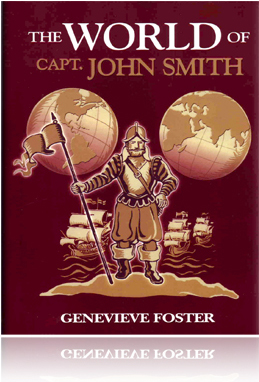
Next you will discover The World of Captain John Smith also by Genevieve Foster. Spanning the years from 1580-1631 the life of the adventurous John Smith gives a picture of the world just before and during the colonization of America. When Smith was a boy, Shakespeare was on his way to London to become an actor, the Spanish Armada had failed to conquer England, Mary Queen of Scots had lost her head, and Akbar the young prince of India sought to rule his people wisely. Galileo was perfecting his telescope and seeing things never before seen by the human eye, while Pocahontas romped the forests of Virginia and saved a young Englishman's life. A little band of Pilgrims seeking to escape religious persecution in England fled to Holland and a little Dutch boy named Rembrandt began to paint. These are just a few of the intriguing personalities, events, discoveries, and advances that made up the world of Captain John Smith and are now made alive to the reader in Foster's masterful way.

Next your student will explore the American colonies with several wonderful books including Poor Richard by James Daugherty. This lively text exemplifies both the man and the artist. Benjamin Franklin lived in turbulent times and met those times head-on with passion and gusto. James Daugherty—ever the patriot himself—has captured that essential nature of Franklin in his energetic and dramatic three-color lithographs that reveal the neophyte as he faces the fresh soil of a young nation filled with optimism and promise. From his Quaker childhood to his early days as printer's apprentice to runaway, to stranger in the City of Brotherly Love, to the "Water American" in London, Ben's youth was filled with adventures and challenges that taught him invaluable lessons about human nature. These lessons would serve him well as he grew to be a leader of the young colonies as they faced the tyranny of Britain. As a leader in the American Revolution he was indispensable as an ambassador to England and later France where he won the hearts of the nation by his simple Quaker wisdom and geniality. All these things were accomplished while he pursued his interests as scientist, inventor, and prolific author. In everything he did, Franklin was always compelled by how he might best serve his fellow man.

One of the best-selling American classics of all time is Johnny Tremain and your student is sure to enjoy the adventures of mischievous Johnny as he takes on the British redcoats. It's a story filled with danger and excitement, and the turbulent, passionate times in Boston just before the Revolutionary War. Johnny, a young apprentice silversmith, is caught up in a dramatic involvement with Otis, Hancock, and John and Samuel Adams in the exciting currents and undercurrents that were to lead to the Boston Tea Party and the Battle of Lexington–and finally, a touching resolution of Johnny's personal life.

The story of how the United States became an independent nation is vividly told in The Great Little Madison. Telling the story of the "Father of the Constitution", author Jean Fritz paints a vivid picture of this fascinating man as well as the government he played such a key role in establishing. Students will learn not only of the reasons why the colonies rebelled from England, but also how the founding fathers developed the US system of government. Fritz brings to life the vigorous debates in Independence Hall, the strong convictions, and the compromises. This book provides a wonderful introduction into government history and political theory for young readers.


George Washington's World provides more history of early America and it's struggles for independence and its formation as an independent country but it doesn't stop there. The period measured by the life of George Washington—1732 to 1799 —was one of revolution and change in many parts of the world as Enlightenment thinking took hold in the minds of men. When George was a young man, Benjamin Franklin was the most well-known American, Louis XV was on the throne of France, and George II was king of England. Father Junipero Serra had just arrived in Mexico to work with the Panes Indians. Mozart and Bach were writing their immortal music and Voltaire warred with his pen against Ignorance, Injustice and Superstition. The young nobleman Lafayette watched the feisty American colonies with fascinated interest as they stood up to Mother England when she sought to tax them unfairly. James Cook was sent by the Royal Society of London to Tahiti where their team of astronomers might observe a total eclipse of the sun and thereby accurately measure the distance between the earth and the sun. These are just a few of the wonderful narratives explored by Foster in her Newbery Honor Book of 1940. Prolifically illustrated with intriguing line drawings and detailed timelines, Foster's telling of the life story of George Washington does justice to the man it celebrates.

Back in the US, a young mathematician was going to revolutionize the world of navigation and your students will get to learn all about this fascinating young man in Carry On, Mr Bowditch. Readers today are still fascinated by "Nat," an eighteenth-century nautical wonder and mathematical wizard. Nathaniel Bowditch grew up in a sailor's world—Salem in the early days, when tall-masted ships from foreign ports crowded the wharves. But Nat didn't promise to have the makings of a sailor; he was too physically small. Nat may have been slight of build, but no one guessed that he had the persistence and determination to master sea navigation in the days when men sailed only by "log, lead, and lookout." Nat's long hours of study and observation, collected in his famous work, The American Practical Navigator (also known as the "Sailors' Bible"), stunned the sailing community and made him a New England hero.

The turn of a century sees much change in the young US as well as an unparalleled opportunity. Of Courage Undaunted by James Daugherty tells of the remarkable expedition of Meriwether Lewis and William Clark on their 3555-mile trek from St. Louis to the Pacific Ocean. Taken largely from original accounts of the expedition, Daugherty has written in his simple, forceful, and lyrical way to evoke the drama and pathos of what was one of American's most daring journeys of discovery. Commissioned in 1803 by President Thomas Jefferson to explore and open up this vast territory, Lewis and Clark felt it was the realization of a lifelong dream. Against the hardships of the wilderness, possible attack by hostile Indians, sudden blizzards and terrifying natural obstacles, these two men led a Corps of Discovery ably and nobly to complete their mission. Their Corps included American Indians from the Sioux, Mandan, Shoshone, Clatsop and Chopunnish tribes as well as one black slave named York. Sacajawea—the only woman on the trip—was a Shoshone who contributed invaluable service as interpreter and guide. Daugherty's evocative sepia and black ink illustrations depict individuals of humor, vitality, passion, and strength.

The course concludes with Abraham Lincoln's World in which Genevieve Foster once again relates the life of a great American and tells what was happening all around the world during his lifetime. Thus, while Abe Lincoln was a boy roaming the woods of Kentucky, Thomas Jefferson was completing his eighth year as president, George III reigned in Great Britain and Napolean was about to meet his Waterloo. Beethoven and Sir Walter Scott were at the height of their creative powers, while Victor Hugo was staging plays at school. By the time Lincoln was old enough to help his father chop wood, other young boys and girls were being prepared for the future parts they would play. Harriet Beecher was reading anything she could get her hands on, Charles Darwin was collecting toads, crabs and shells, and the impoverished boy Dickens was working in a shoe blacking factory in London. When Lincoln opened his shop in Salem, David Livingstone was opening up deepest Africa, and thousands of Americans were opening up the West on the Oregon Trail. The spirit of freedom was moving around the globe as the abolitionist movement gained power in the States and serfdom saw its demise in Russia. Technologically the world was bursting with the invention of the telegraph, the railroad and the steamboat. With her whimsical and informative illustrations and timelines Foster has magnificently captured a remarkable age and a remarkable man.

We hope this gives you a good idea of the wonderful reading adventures that are in-store for the student who chooses our Early American and World History study. Please let us know if you have any questions in the comments section! And if you've completed this study, let us know what you thought. 

Related Posts:


Don't forget to check out our Facebook and Pinterest pages. And if you've enjoyed this, please feel free to share using the buttons below!

Friday, June 08, 2012

Product Feature: Timelines

Our Early American History Timeline
Today I want to feature one of our classic products: our Timelines. For nearly all of our History Through Literature study guides we have developed time lines to accompany your child's history curriculum. These are wonderful tools for reinforcing the chronology of events while being a fun hands-on project! 


Sample pictures from the History of Science Timeline


Each timeline features 18-28 pictures of historical figures, key events, or ideas that were integral to a specific time period. Students color the pictures as they progress through each study and attach them to the included card stock time line. 
Assembly instructions for the Early American History Timeline
Color the pictures is a great activity for restless students to do while you are reading aloud the literature from the history curriculum. As a child my mind focussed much more when my hands were occupied! So for students who have a hard time sitting still during read-aloud time, these are a very effective tool! While the timelines have been designed to correlate with our curriculum they can also be used independently. 


We offer the following timelines (click on any pictures to enlarge):


Our Ancient History Timeline features 28 pictures ranging from Cheops' Great Pyramid in 2600 B.C. to the Fall of Rome in 476 A.D. Pictures include Abraham, Hammurabi, King Tut, Homer, Pythagoras, Cleopatra, Julius Caesar and many others take their place in relation to great historical events like the eruption of Mt. Vesuvius, the building of the Great Wall of China, the Birth of Christ, and the calculation of the circumference of the earth and much more! 


The Medieval History Timeline features 22 figures including Marco Polo, the Scottish Rebellion, the Black Death, Chaucer, Gutenberg, Luther, Joan of Arc, the Spanish Armada, Shakespeare and many more. It begins in 1215 with the signing of the Magna Carta and ends in 1611 with the translation of the King James Version of the Bible. 


Our Early American History Timeline begins in the year 1000 with Leif Eriksson's discover of North America and ends in 1862 with the Emancipation Proclamation. Students will be introduced to the Pilgrims, Pocahontas, the War of 1812, Valley Forge, Continental Congress, Lewis and Clark, and much more. 

The History of Science Timeline marks 22 major scientists and scientific discoveries beginning with the ancients, Pythagoras, Archimedes, and others and continues up through Albert Einstein. Students can color pictures featuring Guttenberg, Pascal, Newton, Marie Curie, and more! 

A fun addition to any music study, the History of Classical Music Timeline features twenty-three illustrations featuing composers from the Baroque, Classical, Romantic and Modern Periods of orchestral composition. Portraits of Vivaldi, Bach, Beethoven, Schubert, Clara Schumann, Liszt, Brahms, Tchaikovsky, Mahler, Stravinsky and others make this a wonderful tool for tracking the changes in musical composition and development. 

Last, but not least, the History of California Timeline features the intrepid men and women who settled the American West. Beginning with Columbus landing in the New World students will color pictures of Balboa, Cortez, Father Serra, Jedediah Smith, Jessie Benton Fremont and many more. The time line ends by marking the completion of the Transcontinental Railroad, that tangible link between the eastern and western coasts. 

All the illustrations on the timelines have been drawn by the talented Christen Blechschmid. This cohesiveness allows the time lines to be linked and used together to complete a more comprehensive picture of world history! 

Pricing for the time lines takes into consideration the fact that many home schooling families have multiple students studying the same subjects and so discounts are applied to multiple copies of the same time line. We also offer bulk discounts for classroom kits. 

Have you used time lines in your history studies? Do you find them helpful? I would love to hear about your experiences! 

Have a wonderful weekend.