Tuesday, September 04, 2012

The Landmark Series–classics from the past for children today!


I hope you all had a great extended weekend. We are shipping out last minute orders and have enjoyed talking with those of you who have called in with curriculum questions. Most of you have probably already started school and are hopefully enjoying all those wonderful new books you ordered and checked out from the library.

This time of year always makes me want to pull out a big stack of books and start reading. For those of you who are looking to fill your library with classics and the stories of great men and women, I would recommend taking a look at the Landmark Series. Originally published between 1950 and 1980, this series provided a historical education to generations of children. Even as a youngster, I knew that if I picked up a "Landmark book" at the library or book store there would be no argument with my parents and I would enjoy it and learn something.

Many of you probably are familiar with these titles and pick them up at used book sales whenever you can. Now, it's a bit easier to get your hands on the books because they're being reprinted. There are currently 26 available and we have them at a special price! 
Isn't that a beautiful collection?

The collection features some of the most interesting people and events in history and if you have a voracious reader who needs a constant stream of material, this is for you. These titles are also excellent for more reluctant readers as they're all very well written and engaging. Each author treats his or her subject in full color and displays history in all its true drama! Series authors include Ralph Moody, Armstrong Sperry, Sterling North, and more! The reprints include original Landmark titles as well as those written in the same tradition after the series stopped printing. 

Here is a complete list of titles:

Abe Lincoln: Friend of the People by Clara Ingram Judson
Alexander the Great by John Gunther
Battle in the Arctic Seas by Theodore Taylor
Invasion: The Story of D-Day by Bruce Bliven, Jr.
Joan of Arc: Warrior Saint by Jay Williams
Lawrence of Arabia by Alistair Maclean
Lee and Grant at Appomattox by MacKinlay Kantor
Pearl Harbor Attack by Edwin P. Hoyt
The Barbary Pirates by C. S. Forester
The Swamp Fox of the Revolution by Stewart H. Holbrook

You can currently get all twenty six titles on our website for a special discounted price! We know building a library is expensive, so here's a great way to get some excellent titles on your shelves while saving money. Get all twenty six titles for $169.95, a savings of nearly $18.00! Click here to order

Thursday, August 30, 2012

Chalk another one up for free time


A recent article as reinforced the fact that kids need free time. We have discussed this before in our entry on boredom as well as in the link on the alarming trend that boys are falling behind in school. Now new studies reinforce what any mother or father knows, kids need down time!

Interestingly in this day of No Child Left Behind and state and national standardization many schools have actually eliminated recess. Some estimate that up to 40% of all schools have done away entirely with the childhood institution with many more schools severely limiting free time. Administrators felt that time would be better spent cramming in as much teaching as possible. This trend hit poor performing schools the hardest, and these schools generally tend to be those that serve the poorest students. So recess was gone, along with art and drama and other classes that would have allowed students to move, express themselves creatively, and have a bit of down time. Now studies are showing that that was a desperately flawed decision when it comes to improving academic performance. Recess is a necessity. Children cannot be expected to sit through a six to eight hour school day without time to just be kids. The most recent research shows that children who have recess are more focused, can concentrate for longer periods of time, and are able to assimilate information more efficiently.

Academics aren't the only thing to show positive change when children have regularly scheduled recess, there are studies that link free time to significant improvements in behavior!

So, I was wondering how you structure your school day? I'm curious to know if you schedule your days after a school model or if it's more relaxed? Have you changed over time? What has worked for your family? Or is each child different? I know children who could sit still for hours, perfectly happy to just read and study, but most children need time to run and play. How do you account for different needs within your family?

To read more, here are links to some interesting and informative articles:
New York Times
Slate Magazine
CNN


You may also enjoy:


Monday, August 27, 2012

What do you think about holding kids back a grade?


The current issue of Time Magazine has an interesting article on a growing trend in the US to hold back 3rd graders who are unable to pass a grade level reading test. My new home state of Florida is one of the most strict when it comes to holding back third graders who do not pass the 3rd grade reading proficiency test and in the first year they enforced this policy 21,799 students were held back, up from 4819 the year before the policy went into effect. According to the article 10% of K-8 students nationwide are held back for one or more years. This percentage balloons to 25% when you only look at low income students. Not only is the cost of holding students back enormous at an estimated $12 billion each year, it has far reaching social effects on the children. As the article states, numerous studies have shown that students who are held back have a higher chance of feeling less connected and show less confidence. On the other hand, some studies have shown a link to greater academic aptitude for those who are given an extra year to develop those reading skills.

Reading this article coincided with me attending a ladies event at a local church where nearly every woman there talked about her lack of creativity. While these two occurrences may seem entirely unconnected, I believe that they share a common root. The modern reliance on standardized tests and standards does not allow for individual expressions of creativity nor does it give space for students who  develop at different rates. This is one of the natural outcomes of an educational system produced by an industrial model.

As someone who continually advocates the importance of reading, I am sympathetic to the need to insure that our students can read proficiently. I am also aware of the challenges teachers face in trying to achieve educational outcomes with a diverse group of students. But I do worry about the long reaching effects on students who are held back and wondered if any of you had experience in this area. Were you ever held back? How did this experience affect the way you looked at school? Have you had a child held back? Did this influence you to seek alternative educational options such a home schooling or private tutoring? Or did you decided to throw out the entire grading system and look toward a more unschooling approach?

Reading this article reminded me of an earlier post on home schooling as an equalizer. Not only have studies proven that home schooled students outperform their public school counterparts on nearly all measures of achievement, it shows the advantages of an educational system that puts the student first. I am also encouraged by studies that show parental involvement is the key to student success, no matter what educational system the student is enrolled in. As highly involved parents and teachers, I am curious how you may have handled the challenge of an "underperforming" student and I'm sure other readers would appreciate hearing your stories as well.

You may also enjoy: 


Thursday, August 23, 2012

FAQ: Books used in our Jr. High and High School Programs


In our previous entry we listed all the books that you read through in our programs for elementary levels, approximately K-6th grade. Now we're going to list all the wonderful books your Jr. High and High School students will read through using our study guides. Remember we offer great discounts on all of our package deals and even offer a Lowest Price Guarantee! Here's the lists:

  • Ancient History Through Literature Study Guide by Rea C. Berg and Rebecca Manor
  • Ancient History Timeline
  • Streams of Civilization, Volume 1 by Stanton and Hyma
  • Streams of Civilization Test Booklet
  • Student Bible Atlas by Tim Dowley
  • Ancient Greece by Christine Hatt
  • Augustus Caesar's World by Genevieve Foster
  • The Bronze Bow by Elizabeth Speare
  • The Children's Homer by Padraic Colum
  • City: A Story of Roman Planning and Construction by David Macaulay
  • D'Aulaire's Book of Greek Myths by Ingri and Edgar D'Aulaire
  • The Golden Goblet by Eloise Jarvis McGraw
  • Galen and the Gateway to Medicine by Jeanne Bendick
  • Pharaohs of Ancient Egypt by Elizabeth Payne
  • Pyramid by David Macaulay
  • Tales of Ancient Egypt by Roger Lancelyn Green
  • The White Isle by Caroline Dale Snedeker


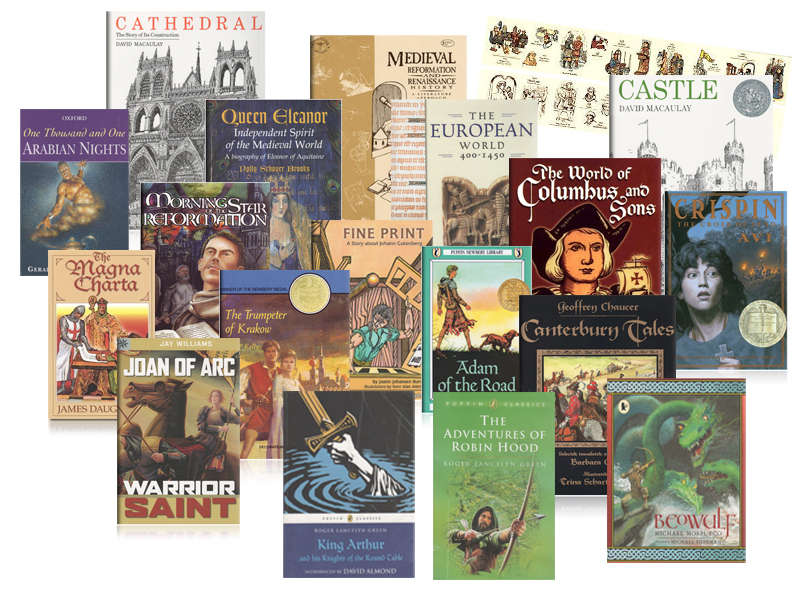
  • Medieval History Through Literature Study Guide by Rebecca Manor
  • Medieval History Timeline
  • The European World 400-1450 by Barbara Hanawalt
  • Beowulf adapted by Michael Morpurgo
  • One Thousand and One Arabian Nights by Geraldine McCaughrean
  • Queen Eleanor, Independent Spirit of the Medieval World by Polly Brooks
  • The Adventures of Robin Hood by Roger Lancelyn Green
  • The Magna Charta by James Daugherty
  • Cathedral by David Macaulay
  • Castle by David Macaulay
  • The Kite Rider by Geraldine McCaughrean
  • Adam of the Road by Elizabeth Gray
  • The Morning Star of the Reformation by Andy Thompson
  • Crispin: The Cross of Lead by Avi
  • The Canterbury Tales adapted by Barbara Cohen
  • Joan of Arc: Warrior Saint by Jay Williams
  • Fine Print: A Story of Johann Gutenberg by Joann Johansen Burch
  • The Trumpeter of Krakow by Eric P. Kelly
  • The World of Columbus and Sons by Genevieve Foster


  •  Early American & World History Through Literature by Rea C. Berg & Rebeca Manor
  • The following titles are all by Genevieve Foster
    • The World of Columbus and Sons
    • The World of Captain John Smith
    • George Washington's World
    • Abraham Lincoln's World
  • Poor Richard by James Daugherty
  • Of Courage Undaunted by James Daugherty
  • Johnny Tremain by Esther Forbes
  • Carry On, Mr Bowditch by Jean Latham
  • The Great Little Madison by Jean Fritz

  • Ancient History Through Literature Study Guide by Rea C. Berg and Rebecca Manor
  • Ancient History Timeline
  • Streams of Civilization, Volume 1
  • Streams of Civilization, Test Booklet
  • Augustus Caesar's World by Genevieve Foster
  • Antony and Cleopatra by William Shakespeare
  • Antony and Cleopatra Max Notes
  • Beyond the Desert Gate by Mary Ray
  • The Children's Homer by Padraic Colum
  • The Cat of Bubastes, A Tale of Ancient Egypt by G. A. Henty
  • Caesar's Gallic Wars by Olivia Coolidge
  • D'Aulaire's Book of Greek Myths by Ingri and Edgar D'Aulaire
  • The Greek Way by Edith Hamilton
  • Julius Caesar by William Shakespeare
  • Mara, Daughter of the Nile by Eloise Jarvis McGraw
  • Pharaohs of Ancient Egypt by Elizabeth Payne
  • Quo Vadis? by Henryk Sienkiewicz
  • Student Bible Atlas by Tim Dowley
  • Tales of Ancient Egypt by Robert Lancelyn Green


Medieval History Through Literature for High School (Available Soon!)
  • Medieval History Through Literature Study Guide by Rebecca Manor & Rea Berg
  • Medieval Literature in Translation edited by Charles W. Jones
  • One Thousand and One Arabian Nights by Geraldine McCaughrean
  • Beowulf translated by Seamus Heaney
  • The Magna Charta by James Daugherty
  • The Canterbury Tales by Geoffrey Chaucer
  • The Scottish Chiefs by Jane Porter
  • Joan of Arc, Warrior Saint by Mark Twain
  • The World of Columbus and Sons by Genevieve Foster
  • The Medieval World, An Illustrated Atlas by John M. Thompson

  • Modern US and World History Through Literature Study Guide by Rea C. Berg
  • Across Five Aprils by Irene Hunt
  • All Quiet on the Western Front by Erich Remarque
  • Around the World in Eighty Days by Jules Verne
  • Bully for You, Teddy Roosevelt by Jean Fritz
  • Harriet Beecher Stowe and the Beecher Preachers by Jean Fritz
  • The Jungle by Upton Sinclair
  • Reconstruction: Binding the Wounds edited by Cheryl Edwards
  • The Red Badge of Courage by Stephen Crane
  • Rifles for Watie by Harold Keith
  • Sojourner Truth: Ain't I a Woman by Patricia McKissack
  • Uncle Tom's Cabin by Harriet Beecher Stowe 
  • Up From Slavery by Book T. Washington
  • The following titles are by Albert Marrin
    • Virginia's General 
    • The Yanks are Coming
    • Stalin Russia's Man of Steel
  • A History of Us: An Age of Extremes by Joy Hakim
  • A History of Us: War, Peace, and All that Jazz by Joy Hakim


  • To Kill a Mockingbird by Harper Lee
  • No Promises in the Wind by Irene Hunt
  • The Hiding Place by Corrie Ten Boom
  • Number the Stars by Lois Lowry
  • The Story of the Trapp Family Singers by Maria Augusta Trapp
  • Anne Frank, Diary of a Young Girl by Anne Frank
  • The Endless Steppe by Esther Hautzig
  • Hiroshima by John Hersey
  • The House of Sixty Fathers by Miendert DeJong
  • So Far From the Bamboo Grove by Yoko Kawashima Watkins
  • The Vietnam War: How the United States Became Involved ed. Mitch Yamasaki
  • Journey to Topaz by Yoshico Uchida
  • A History of Us: All the People by Joy Hakim
  • The following titles are by Albert Marrin
    • Hitler
    • Victory in the Pacific
    • America and Vietnam


I hope this helps give you a better idea of all the wonderful books you'll be reading when you choose one of our study guides! And if you have any questions, please feel free to leave them in the comments below! 

You may also enjoy:


Wednesday, August 22, 2012

FAQ: What books are used in our curriculums?


On our Facebook Page, I got a question that I realized many of you probably have. What books are used in our study guides? It's one of those questions that escapes our notice because we're so familiar with all the books, but many of you may not know what treasures you'll be reading when you choose to do one of our programs. The fastest way to discover what books are used in each study is to visit our website and click on the "Literature Packs" tab. Under each pack you will see all the books listed individually–those are the books you'll be reading through during the school year! For a quick reference, I'm also going to list them below. We'll start with our K-3 programs and work our way up through the high school level programs. I will also provide links to the packs we have available on our website. Remember, we offer a Lowest Price Guarantee on all our packs and give you the option to customize the packs if you already own up to five of the titles! 

  • Early American History Study Guide by Rea C. Berg
  • Leif the Lucky by Ingri and Edgar D'Aulaire
  • Columbus by Ingri and Edgar D'Aulaire
  • Pocahontas by Ingri and Edgar D'Aulaire
  • Benjamin Franklin by Ingri and Edgar D'Aulaire
  • George Washington by Ingri and Edgar D'Aulaire
  • Abraham Lincoln by Ingri and Edgar D'Aulaire
  • Squanto, Friend of the Pilgrims by Clyde Bulla
  • Pilgrim Stories by M. Pumphrey, edited by Rea Berg
  • The Pilgrims of Plimoth by Marcia Sewall
  • Meet Abraham Lincoln by Barbara Cary
  • A More Perfect Union by Betsy and Guilio Maestro
  • The Matchlock Gun by Walt Edmonds
  • The Courage of Sarah Noble by Alice Dalgliesh
  • The Forth of July Story by Alice Dalgliesh
  • George Washington's Breakfast by Jean Fritz
  • Winter at Valley Forge by James Knight
  • Jamestown, New World Adventure
  • The Year of the Horseless Carriage 1801 by Genevieve Foster
  • Benjamin West and his Cat Grimalkin by Marguerite Henry
  • 4 Audio CDs featuring the stories of Columbus, the Pilgrims, and Abraham Lincoln


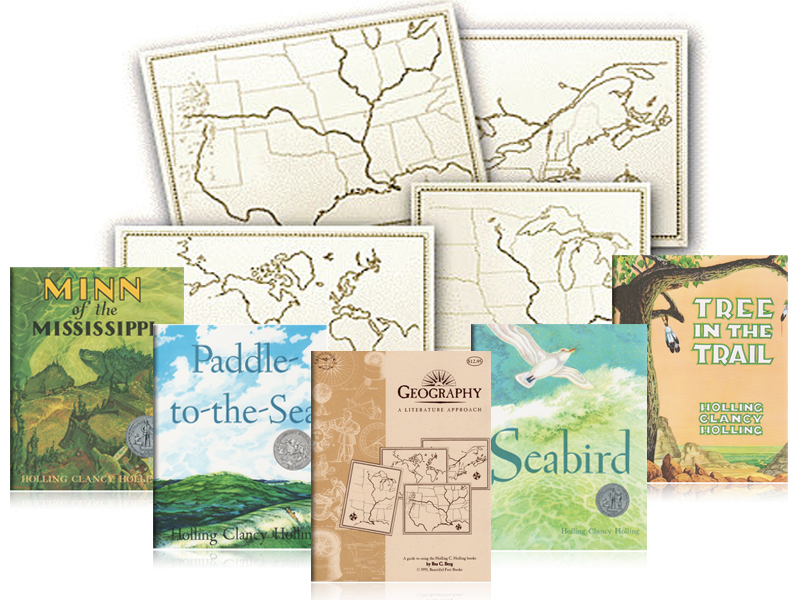
  • Geography Through Literature Study Guide by Rea C. Berg
  • The following titles are all by Holling C. Holling
    • Paddle to the Sea
    • Minn of the Mississippi
    • Tree in the Trail
    • Seabird
  • Set of Four Maps, these maps have been specifically designed to go along with each book!

  • Teaching Character Through Literature Study Guide by Rebecca Manor
  • A Time of Wonder by Robert McCloskey
  • The Runaway Bunny by Margaret W. Brown
  • Boys and Girls of Colonial Days By Carolyn Sherwin Bailey
  • Brave Irene by William Steig
  • The Clown of God by Tommy DePaola
  • The Courage of Sarah Noble by ALice Dalgliesh
  • Miss Rumphius by Barbara Cooney
  • Owl Moon by Jane Yolen
  • Obadiah the Bold by Brinton Turkle
  • Rachel and Obadiah by Brinton Turkle
  • Wilfrid Gordon McDonald Partridge by Mem Fox
  • When I was Young in the Mountains by Cynthia Rylant

  • History of the Horse Study Guide by Hilary Severson
  • Black Beauty by Anna Sewell
  • The Black Stallion by Walter Farley
  • Handbook of Horses by Elwyn Edwards
  • Draw 50 Horses by Lee James
  • Horses of the World card game
  • The following titles are by Marguerite Henry
    • Album of Horses
    • Brighty of the Grand Canyon
    • King of the Wind
    • Justin Morgan Had a Horse
    • Misty of Chincoteague
    • Mustang, Wild Spirit of the West
    • White Stallion of Lipizza

  • California History Through Literature Study Guide by Rea C. Berg
  • California HIstory Timeline by Rea C. Berg
  • Columbus by Ingri and Edgar D'Aulaire
  • Cruise of the Arctic Star by Scott O'Dell
  • Zia by Scott O'Dell
  • Patty Reed's Doll By Rachel Laurgaard
  • By the Great Horn Spoon by Sid Fleischman
  • Riders of the Pony Express by Ralph Moody
  • Jessie Benton Fremont–California Pioneer by Marguerite Higgins
  • Blue Willow by Doris Gates
  • Song of the Swallows by Leo Politi
  • Island of the Blue Dolphins by Scott O'Dell

  • History of Western Expansion Through Literature Study Guide by Rea C. Berg
  • Abraham Lincoln by James Daugherty
  • Abraham Lincoln's World by Genevieve Foster
  • Amistad: The Slave Uprising Aboard the Spanish Schooner by Helen Kromer
  • The Boy Who Drew Birds: A Story of John James Audubon by Jacqueline Davies
  • Daniel Boone: The Opening of the Wilderness by John Brown
  • Frontier Living by Edwin Tunis
  • Of Courage Undaunted by James Daugherty
  • The Stout-Hearted Seven: Orphaned on the Oregon Trail by Neta Lohnes Frazier
  • The Year of the Horseless Carriage by Genevieve Foster

  • Early American History Through Literature Intermediate Study Guide by Rea C. Berg
  • Early American History Timeline by Rea C. Berg
  • Leif the Lucky by Ingri and Edgar D'Aulaire
  • Columbus by Ingri and Edgar D'Aulaire
  • Pocahontas by Ingri and Edgar D'Aulaire
  • Benjamin Franklin by Ingri and Edgar D'Aulaire
  • The Landing of the Pilgrims by James Daugherty
  • The Lewis and Clark Expedition by Peter Copeland
  • A More Perfect Union: The Story of Our Constitution by Betsy and Guilio Maestro
  • Abe Lincoln Grows Up by Carl Sandburg
  • America's Paul Revere by Esther Forbes
  • America's Providential History by S. McDowell and M. Beliles (optional)
  • Amos Fortune, Free Man by Elizabeth Yates
  • The Life of Washington by Josephine Pollard
  • Go Free or Die, A Story about Harriet Tubman by Jeri Ferris
  • Sacajawea, Guide to Lewis and Clark by Della Rowland
  • Walking the Road to Freedom by Jeri Ferris
  • William Bradford, Pilgrim Boy by Bradford Smith
  • The Vikings by Elizabeth Janeway
  • 4 Audio CDs featuring the stories of Columbus, the Pilgrims, and the story behind the U.S. Flag

  • The History of Science Study Guide by Rebecca Manor
  • The History of Science Timeline
  • Explorabook by John Cassidy
  • The Picture History of Great Inventors by Gillian Clements
  • The New Way Things Work by David Macaulay
  • Along Came Galileo by Jeanne Bendick
  • Archimedes and the Door of Science by Jeanne Bendick
  • The Story of Thomas Alva Edison
  • Albert Einstein, Young Thinker by Marie Hammontree
  • Marie Curie's Search for Radium by Beverly Birch and Christine Birmingham
  • Ben Franklin of Old Philadelphia by Margaret Cousins
  • Pasteur's Fight Against Microbes by Beverly Birch
  • Scientists card game
  • The Science Experiment Pamphlet


  • The History of Classical Music Study Guide by Rebecca Manor
  • The History of Classical Music Timeline
  • Set of 18 CDs, these feature the biographies and music of 21 composers!
  • Dance Me a Story by Jane Rosenberg
  • The Story of the Orchestra Book and CD set by Robert Levine
  • Spiritual Lives of the Great Composers by Patrick Kavanough
  • Musical Genius by Barbara Allman
  • Farewell Symphony by Anna Harwell Celenza
  • Coloring Book of Great Composers, Chopin to Tchaikovsky
  • Coloring Book of Great Composers, Mahler to Stravinsky
  • Composer card game
There you have all the books listed for our Primary and Intermediate program, those appropriate for students from Kindergarten through 6th grade. Tomorrow I will provide book lists for our Jr. High and High School programs. And be sure to keep asking those questions! We're happy to help with any information we can provide.

You may also enjoy:


Monday, August 20, 2012

Another chance to study literature with Rea Berg!


For all you readers in California, you have another opportunity to sign up for one of Rea Berg's literary parties! Here's the details from Rea:

Hello Fellow Book Lovers,
Rough winds do shake the darling buds of May,
And summer’s lease hath all too short a date.–Shakespeare, Sonnet 18

Well, summer’s lease is nearly over, and despite our wish that it could linger just a bit longer, school days will shortly be upon us!  So, to give us all a boost (myself included), I am hosting a “Back to School” Literature Soirée on Saturday, September 8.  I will cover more literary analysis, but this time we will look at how to analyze historical literature within the context of the heroic quest.  This will be a fun adventure as we consider how the heroes and heroines of the eras of exploration, discovery, and colonization provide examples of heroic archetypes fulfilling their own unique destinies.
I will present an overview of the best historical works for children covering the period of the early 1600s up through the Civil War.  The concentration will be early American History, but some world history will naturally be a part of that.  So roughly speaking, here is how the day should go:
9:30-10 am: Arrival and get acquainted with a cup of coffee or tea
10 am-10:30: a brief session will look at current statistics of American student’s knowledge of history and literature as well as the why’s and wherefore’s of the “notebook approach”
10:30-11:30 am: the best children’s literature of Early American Exploration, Discovery, and Colonization
11:30 am-noon: Analyzing historical literature using the elements of the heroic quest (definition and overview), anthropomorphism, the orphaned child literary trope, and others!  (not to worry, I will clearly define all of these before setting you out on your own).
Noon-1:45: Working lunch applying literary analysis to various works of historical literature. This time we will work in pairs to save time
1:45-2 pm: Coffee Break
2:00-3:00 pm: the best Children’s Literature of the American Revolution–the Civil War
3:00-3:30 pm:  Wrap up and feedback on take away
So to recap: Saturday, September 8, 2012
At my home: 1306 Mill Street, San Luis Obispo
Time: 9:30 am–3:30 pm
Cost: $30 (which will include lunch– please email me if you need gluten free or vegetarian)  You can register here.
Finally, this soiree is already half booked with ladies returning from our summer session.  So please register soon, to insure you have a place!

If you have attended one of Rea's events, you know it's a wonderful time of meeting other likeminded home schooling parents and working together on fun assignments, expanding your knowledge, and really being recharged and re-inspired. 

If you would like to book a literary event at your home with Rea, please contact her at 
rea (@) bfbooks (.) com to discuss the details.  

Friday, August 17, 2012

The Merits of Memorization


I recently read an interesting article on the disappearance of memorization activities in our school systems. While the author makes some political statements I find unnecessary to the broader context of the issue, it was fascinating to think about how our children no longer memorize passages of poetry, great speeches, or other things of literary value. 

As a child I had to memorize some poetry and can still recall the opening lines to Longfellow's The Village Blacksmith, "Under the spreading chestnut tree, the village smithy stands..." In college I had a professor who required each student to memorize a passage of poetry each week. While much of what I  crammed into my head has disappeared into the dusty reaches, I can still relish the haunting lines of Blake's The Tyger

There is something about memorizing poetry that allows students to revel in the pleasure of beautiful language. Often this is something overlooked in our modern curriculums as they strive for efficiency and production, but I would argue that cultivating an enjoyment of language is a wonderful skill to give your children and students. 

There are many poems that just seem to be made for memorization. My youngest sister used to entertain all of us with her adorable rendition of Great Grey Elephant

Great grey elephant
Little yellow bee
Tiny purple violet 
Tall green tree

Red and white sailboat on a blue sea
All these things You gave to me
When you made my eyes to see
Thank you God!

I was not always a fan of poetry, I found it too symbolic, too flowery, too overwrought. But in college I had a professor who opened up the fact that poetry is linguistic gymnastics and poets are having fun with the boundaries of grammar. What a different way of looking at it! So, I was wondering if any of you have your students memorize poetry? If so, what poems do you find work best with youngsters? What about older students?

I love some of the classics like The Midnight Ride of Paul Revere, All Things Bright and Beautiful, Flint by Christina Rosetti, others by Robert Louis Stevenson, George MacDonald, G. K. Chesterton, and Longfellow. What poems have you memorized?


One excellent resource for introducing your children to poetry as well as the linguistic tools used by poets is A Child's Introduction to Poetry by Michael Driscoll. It includes an interactive text as well as an audio CD of poetry readings.

You may also enjoy: