Monday, February 23, 2015

Learning with Littles

Source

The earlier the better, right?

There has been a commonly held belief that the earlier formal education begins the better the outcomes for children. This belief, widely accepted and promoted, is behind preschool reading programs, head-start schools, and other educational initiatives that often find widespread political support. It is now expected that when a child enters kindergarten, he will have a grasp of the alphabet and may be able to write his name. But what if the evidence contradicted these initiatives? What if the early introduction of formal education actually had the opposite effect of what was intended? What if evidence showed that play was more important than lessons for youngsters?

What the research says

I am fascinated by educational research, as regular readers have probably deduced. Just like nutritional research so much information is contradictory and confusing because anyone can find numbers or a study to support their position. What I am most interested in is research that ends up supporting long-held beliefs and traditions. There may be a thousand studies that elevate one food group above another but they all eventually fall by the wayside as researchers agree that moderation and exercise are truly the keys to healthy living–not an açai berry and flax seed or no carb diet. Much the same is true of educational research, so when I started reading about programs designed to get children reading and learning math principles as early as 3 or 4 years of age, I had a sense that something was amiss. 

Sure enough, an article at The Conversation website shows that:
"There is no research evidence to support claims from government that “earlier is better”. By contrast, a considerable body of evidence clearly indicates the crucial importance of play in young children’s development, the value of an extended period of playful learning before the start of formal schooling, and the damaging consequences of starting the formal learning of literacy and numeracy too young."
This is something every parent has probably sensed as they watch their child grow and learn. I get weekly emails from a parenting website that lists developmental milestones my son ought to have reached. After reading these for weeks and finding them to be nothing but a source of anxiety I quit opening those emails because I found that my son learns at his own pace. Sometimes he hits a milestone weeks before the email outlining that one hits my inbox, other times it's weeks afterwards. This is something parents catch on to and when we do our anxiety is lessened as we accept the individuality of our children and enjoy watching them develop at their own pace. But our culture is one based on measurable achievement so when our children reach school age (now seen as 3 or 4) the pressure is back on.

Achievement based programs in preschool

With the pressure on schools to prove performance through testing, more and more schools are introducing structured educational lessons in pre-K programs. Instead of Kindergarten purely being about play, creative exploration, and social interaction, schools are now expected to teach subjects that have "measurable" outcomes. The trouble is that at this age children's brains may not be ready to process these sorts of lessons. 

Playing is more important!

Source
On the contrary, research has shown that playing causes developments linked to "enabling humans to become powerful learners and problem solvers" (link). Pushing formal learning before children's brains are reading to process it causes a short-circuit in this development! There is a tragic irony at work here. Researchers James Christie and Kathless Roskos have compiled evidence that shows "a playful approach to language learning offers the most powerful support for the early development of phonological and literacy skills!"

I think that this sort of evidence should be so encouraging to parents, especially homeschooling parents! There is a beauty in allowing children to just be children. When you create an atmosphere of learning within your home environment and provide stimulating toys, read stories, play games of imagination–this can all be chalked up to education but without the stress of formal instruction. Parents of young children can enjoy those precious years of play without feeling as though their children are going to fall behind. In fact, they are laying the groundwork for academic success! In fact, according to other research the reading-ability gap between children who begin formal education at age 5 verses age 7 disappears by age 11–except that the group who began younger has a negative attitude toward reading and scores lower on text comprehension. 

The article linked above has all sorts of links to studies and further analysis if you are interested in learning more. And I want to hear from you? Have you pursued a play-based approach to the early years? What does your homeschool look like for your youngsters? How has pursuing a Charlotte Mason approach helped you feel comfortable in a less-structured approach? Or have you found success with a more formal approach?

We would love to hear what you think! Chime in below in the comments section and share your thoughts. Don't forget to check out our Facebook and Pinterest pages.  To learn more about Beautiful Feet Books, click hereAnd if you've enjoyed this, please feel free to share using the buttons below!

Monday, February 16, 2015

Happy President's Day!

Today Kathy shares a memory of learning about George Washington. Enjoy!    

 Box Day was here at last! As my husband opened the boxed marked “Beautiful Feet Books” we held ourselves in eager anticipation as to the contents inside. What would we find? Would we discover a new favorite? Would we be reunited with an old friend? As the box opened our six year old daughter eagerly began to dig through the contents exclaiming, “Books! Books! Look at all of the wonderful books!”  Eager to begin, she selected one of the D’Aulaire books, headed for the sofa announcing to our family, “It’s time to read!” As I looked through the books, my eyes were riveted to one book in particular, George Washington’s Breakfast by Jean Fritz, with illustrations by Paul Galdone. This particular title had been a favorite of mine during my second grade year of elementary school. Our teacher, Mrs. Sheridan had read it aloud to our class on President’s Day. As I touched the cover, I was reunited with an old friend whom I had not seen for over thirty years. While my husband and daughter were reading together from the D’Aulaire’s Ben Franklin I went to sit in my favorite chair to begin.  
George Washington’s Breakfast tells the story of a young boy named, George W. Allen who is named after the Founding Father of our nation and who happens shares the President’s birthdate as well. Because of this coincidence, George is drawn to learn all he can about the historical events and details of his namesake’s life. However, there is one question which George W. Allen is unable to find the answer to: What did George Washington have to eat for breakfast? Thus, George sets out on his quest to learn the answer to this puzzling riddle. He enlists the help of the local librarian, Miss Willing, and his parents. During the search it is revealed that George Washington liked to count things like what
was served for breakfast in Washington’s time period but no hint is given as to what he actually ate for breakfast. 

Determined not to give up, George W. Allen returns to the library where he and Miss Willing learned all sorts of interesting facts about our nation's first president but nothing about what he ate for breakfast. Encouraged by Miss Wiling, George and his parents visit the Smithsonian Institution and Mount Vernon in the hope of discovering the missing puzzle piece. However, George and his family return home without having solved the mystery of what Washington ate for breakfast. In the true style of his namesake, George Allen exclaims upon being told that he should maybe give up his quest, “Give up! You expect me to give up! George Washington’s soldiers were starving, and they didn’t give up. They were freezing, and they didn’t give up. What do you think I am?”1  

Disappointed but determined, George retreats to the family’s attic for some peace and quiet. He notices a box beside him and begins to rummage through its contents. Within the box, he discovers an antique book titled, The American Oracle by Samuel Stearns. Within the pages he locates a chapter titled, “The Character of George Washington.” As he reads, he discovers the Founding Father of our country breakfasted on “three small Indian hoecakes and as many dishes of tea.”2 Elated with joy, George and his grandmother prepare and serve the family “George Washington’s Breakfast.” 
   
I smiled as I closed the book. George Washington’s Breakfast was the book which allowed me to make the connection of historical facts being linked with a real person. A spark had gone off in my mind which burned into a flame. The main character in the book was a real person. Not a figure on a poster, a painting in a book, but a real, live person who had helped to shape and mold our country into the United States of America. I became consumed with the study of American historical figures from the perspective of a second grader. I perused the D’Aulaire's biographies: George Washington, Abraham Lincoln, Ben Franklin, and Pocahontas, the Discovery Biography Series and even the SRA Reading Lab Library. My desire to learn more about America’s historical figures led me to my first Scholastic Books purchases, The Adventures of George Washington by Mickie Davidson and True Stories About Abraham Lincoln by Ruth Belov Gross. 

President’s Day 2006 dawned with a slate gray, winter sky. Inside our home, my daughter and I had gathered for a special story of the day. As I showed the book to my daughter, she exclaimed, “Look, Tomie dePaola drew the cover!” Snuggled together on the sofa, we began the story, “George W. Allen was proud of two things, his name and his birthday…" It was fun to watch my daughter as she traveled along with George W. Allen on his adventure to discover what the Founding Father of Our Country ate for breakfast. She was especially delighted with the illustrations by Paul Galdone, one of her favorite picture book illustrators. Afterwards, we went out to our kitchen to make hoe cakes just as George and his grandmother had done in the story. The hoe cakes were pronounced, “Delicious!” and consumed with fervor both by mother and daughter.

As I look back through time, this book has become part of our family’s fabric of life. It is an old friend; someone with whom we visit once a year to commemorate the American Spirit which founded our country, the United States of America. 

Hoe Cake Recipe

1 cup flour
1 cup corn meal
1-1/2 teaspoons baking powder 

1/2 teaspoon salt 
2 eggs
1 tablespoon sugar
¾ cup milk
1 tablespoon lemon juice
1/3 cup water
¼ cup vegetable oil
2 tablespoons vegetable oil for frying
Mix all ingredients together in a large mixing bowl, except the 2 tablespoons of vegetable oil. Stir with a wooden spoon until the mixture is smooth and free of lumps. Heat the 2 tablespoons of oil in a large skillet or griddle over medium heat. Spoon the batter (2 tablespoons) onto the hot skillet. Fry each hoe cake until it becomes crispy and brown. Flip with a spatula and brown the other side. Remove each hoe cake with a spatula, and set to drain on a paper towel lined plate. Serve hot with butter, maple syrup or honey.

Bibliography

1. Fritz, Jean, “George Washington’s Breakfast,” United States of America: The Putnam & Grosset Group, 1969

2. Ibid.

Tuesday, February 10, 2015

10 Ways to Improve your Homeschool...

An article caught my eye last week and I had to share it here! So much of it goes along with our philosophy at BFB and I know you'll enjoy reading it. Pam Barnhill writes at edsnapshots.com and her article "The 10 Best Things You're Not Doing for Your Homeschool" is great! And, if you're using BFB, you're probably doing most of the things already, but it's always affirming to have someone let you know you're on the right track.
There were a couple of points that really stood out to me and I'd like to quickly summarize them here.

"Resign yourself to the fact that read aloud time does not have to be quiet and serene to be effective. Set up some simple rules like ‘you are free to play with any quiet toy as long as you are listening’ and ‘keep your hands to yourself.’"

This is so true and something my family struggled with along the way. When you're doing your read aloud time it's often really helpful to provide a hands-on project for busy little people. We often encourage parents to allow their youngsters to color during read-aloud time. In our Early American History programs students are often instructed to color pages photocopied from the read-aloud books. This is an easy way to occupy those restless little hands. Other children need to build towers and cities so having legos or block available will make read-aloud time more enjoyable for everyone.

I also love Barnhill's encouragement to moms to become livelong learners themselves. As a mom myself I know that more than anything else my example is what will stay with my children when they grow up. Our children are mirrors that show us our own hipocracy and failings more clearly than anything and if we want to grow a love of learning in them, we have to love learning ourselves. Beyond that, Barnhill points out that always learning reminds us of the difficulties involved in that process:

"In addition to modeling learning, the act of learning ourselves reminds us of the difficulties of being a student. As I struggle to learn to knit I have a greater empathy for my kindergartener struggling with letter formation. I am reminded of how difficult learning a new skill is and how often I need to practice with patience to master it."
I would highly recommend taking some time and reading through the entire article. You'll be encouraged and reminded of why you homeschool in the first place. 

All quotes and image from: http://edsnapshots.com/homeschool-success/

We would love to hear what you think! Chime in below in the comments section and share your thoughts. Don't forget to check out our Facebook and Pinterest pages.  To learn more about Beautiful Feet Books, click hereAnd if you've enjoyed this, please feel free to share using the buttons below!

Monday, February 02, 2015

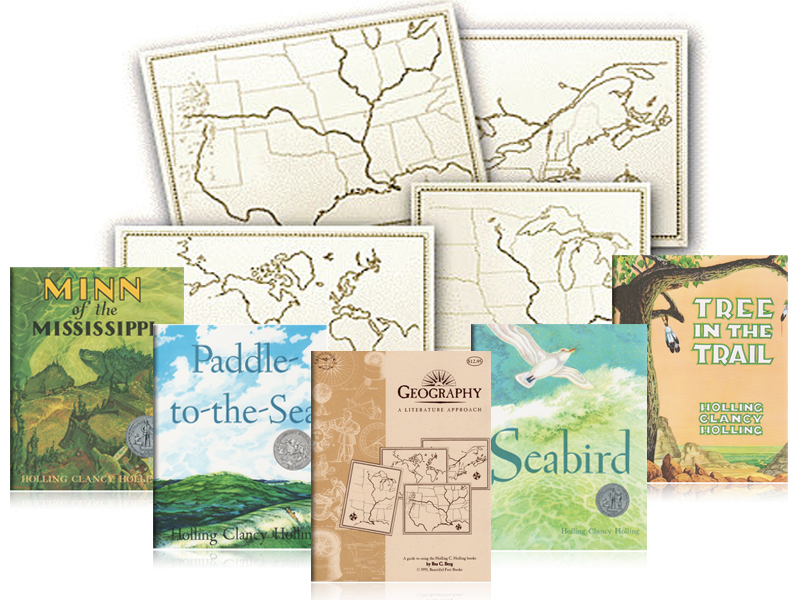
Audria reviews our Geography program

Today, I'm reposting a review written by Audria Story on her blog, At The Well. She wrote about our Geography, A Literature Approach program and I just had to share it here. She shares pictures of her children working diligently on the maps and talks all about how they worked through the program, what they chose to supplement, and much more. Enjoy!
Just before Christmas we wrapped up our Geography a Literature Approach guide from Beautiful Feet Books. The guide is built around four delightful Holling Clancy Holling books. Each book has an accompanying map to explore along with several suggestions (mostly books) for further expansion of studies. We’ve taken our time through this study, starting last summer during our break from regular academics. Once our regular coursework started back up we only worked on the maps and lessons once a week. The crew always looked forward to geography on Friday and were kinda sad when the study concluded. We (including me) love this study and I recommend hunting down as many of the extra books from the guide you can find. I will list our favorite books and resources below. I sorta wish I had bought myself a set of the maps to work on. Several times the kids shooed me away from their maps! The maps are really nice and high quality and stood up to my boys not so delicate treatment. We marked geographical features, colored in states, labeled capitals, and marked various routes from the books. The map work was my crew’s favorite part of the study.
geography lessons
geography lessons
The first book in the study we read was Paddle to the Sea by Holling. We truly enjoyed this book and marked the little boat’s route from Lake Nipigon above the Great Lakes to the Grand Banks off Newfoundland. From there the little carving is picked up by a sea-boat and taken to France. It is eventually returned to the Lake Nipigon area. We went down a few rabbit trails and learned about ponds, rivers, and the Great Lakes. Each did a one page report on the type of wildlife found along the area. They learned about the Canada Goose, copper and iron industry, canal locks, and how electricity is generated by Niagara Falls. I mostly did YouTube searches on these topics and several links are also provided in the guide. For our animal study I have some old encyclopedias the kids used and we read Pond and River, An Eyewitness Book by Steve Parker. Our favorite books were Champlain: A Life of Courage by William Jacobs and Cartier Sails the St. Lawrence by Esther Averill. These books follow the lives of two North American explorers. I know very little of Canadian history so I found these books just as interesting as the kids. Our favorite was the book about Jacques Cartier. We also read through chapter four in Susan Wise Bauer’s The Story of the World Volume Three.
homeschool mess
homeschool mess
The second book is Tree in the Trail. This book is about a cottonwood tree growing along the Santa Fe Trail and eventually traveling the trail as an ox yoke. We traced the route of Francisco Coronado and learned more about the conquistadores inThe King’s Fifth by Scott O’Dell. The crew studied and wrote about cottonwood trees, buffalo, mountain men and the beaver trade, Plains Indians and the introduction of the horse to the American West. Our favorite book for this study, also by Scott O’Dell, was Sing Down the Moon. We all cried reading about the Navaho Trail of Tears. My crew took this book to heart and were upset to learn just how terribly the Native American people were treated. Some things in history are hard to teach especially the sins of one’s own country. During this time we started watching The West by Ken Burns. The program is about nine hours all together and we broke it up over a few weeks. We also made some Navajo frybread (can’t believe I forgot to take pictures!!!) and I told the kids stories about going to Pow-wows when I lived in Oklahoma. Some people like to put butter and honey on fry bread but I prefer mine with a bowl of buffalo chili.
Sparkles and her map from Tree in the Trail
The third book was Minn of the Mississippi. In this book we followed the life and explorations of an alligator snapping turtle from the origins of the Mississippi River to the Gulf of Mexico. For me this was the hardest book to read. I really struggled with some of the phonetically written accents. Also an immense amount of history is crammed into this little book so I just picked over some of the information. My crew wrote in their composition books about the life cycle of snapping turtles, explorers Jacques Marquette and Louis Joliet, North American Ice Age, river trade, the French fur trade, the Twin
page from Oldest's note book
page from Oldest’s note book
Cities, Mark Twain, steamboats, the New Madrid Earthquake of 1811-12 (we live near the fault area!), southern agriculture, the Siege of Vicksburg and the Civil War, and sea tides. We spent more time exploring some topics over others. Our favorite extra book in this part of the study was The Explorations of Pere Marquette by James Kjelgaard. My crew loved this book so much they would beg me to read “just one more chapter”. We read a few legends of Paul Bunyan and watched the Disney cartoon. We watched an episode of American Lives about Mark Twain and really enjoyed learning about life on the Mississippi from the famous author. Oldest requested some of Mr. Twain’s books to be added to his reading requirements after watching the program.
blacklight map
blacklight map
The final book was Seabird. My crew had a hard time deciding if this or Paddle to the Sea was their favorite book in the study. This part of the study is a basic overview of world geography. They learned about Eskimos, whaling (which really fascinated the boys), scrimshaw artwork, types of boats, and life at sea. I just want to share that you should not “google” for images of scrimshaw work with your kids in the room. Some of those sailors preferred…adult imagery! For this study Oldest got creative with his map. He used colored pencils that glow in a blacklight to mark the borders of countries (really vague borders at times) and to add in famous landmarks of some of the countries. He had a lot of fun researching his self-assigned project.
20150120_102710 (480x640)20150120_102438 (476x640)20150120_102239 (640x462)My crew loved this gentle introduction to geography and I enjoyed teaching it to them and at times learning alongside them. I have even caught my hands-on, reluctant reader with the Hollings’ books a few times. The guide is recommended for grades three through seven. The introduction at the beginning of the guide gives clear recommendations and advice for implementation. I gave longer and more researched based assignments to my Oldest. My younger two gave many oral narrations and drew pictures about the topics we explored. Our favorite reference resources for drawing were several books by Edwin Tunis and Google images.
My kids always looked forward to geography time…and so did I.

Monday, January 19, 2015

"We all God's children"

In honor of Martin Luther King, Jr. day, Kathy is sharing the story of her grandmother's friendship with a remarkable woman names Miss Lena. I hope you enjoy:

As I was scanning the book section of a local thrift shop, my eyes came to rest on a particular title, The Help by Kathryn Stockett. I thought to myself, “Hmm, I wonder if the title implies what I think it does?” I picked the book up, read through the synopsis and decided it would be my purchase of the day.  Later in the evening, I began reading. As the minutes went by, I was transported to the south of my childhood. I was introduced to Aibileen, Minny, and Skeeter. Aibileen and Minny are two black maids who work for the upper middle class white families and are commonly known as “the help.” Skeeter, a member of a prominent white family, and journalism graduate of Ole Miss, observes the division and racial tensions in the town of Jackson. While she ponders the situation, a spark ignites, which turns into a fire in her belly. Through a series of events she begins to collect interviews from “the help” which not only turns into a national best-selling book, but cements the friendship of two black women and a white woman during the turbulent years of the Jim Crow south. After I finished the last page, I smiled. Kathyrn Stockett’s best -selling novel was reminiscent of the friendship my maternal grandmother, Gram and I shared with a black woman named Miss Lena. Today, I would like to share with you the story of our friendship which spanned across two generations. 

For as long as I could remember, Gram and Miss Lena had been friends. Their friendship formed from a local church circle they belonged to. During my childhood, I remember Gram saying, “I’m going to visit Lena today.” I often accompanied Gram on these visits to The Hollow, Miss Lena’s predominately black neighborhood. Upon arriving at Miss Lena’s home, we were greeted with true southern hospitality. The first thing that caught my eye was the painting of the “Black Jesus” hanging in the center of the living room wall, flanked by a picture of Abraham Lincoln on the right and a photo of Dr. Martin Luther King, Jr. on the left. Miss Lena saw me gawking at the wall adornments and said, “Everyone sees Jesus in his own way. The Negroes see him as black, the whites see him as white, and the Chinese see him as yellow. It doesn’t make any difference, because we all God’s children.” When I asked who the other two gentlemen were, she began what was to become my first lesson in “civil rights” education. Gently, she explained how Abraham Lincoln had freed the slaves and how Dr. King was working to earn the same rights for black people as the white people had. Miss Lena’s oration had satisfied my inquisitive mind at the moment but had given me a thirst to learn more about the history of the civil rights movement.

As my formative years sped by into adolescence, my friendship with Miss Lena went to a deeper level as did my education on the topic of civil rights. Our conversations would take place over a cup of hot cocoa with marshmallow cream on top which Miss Lena had prepared for me. Miss Lena’s great grandparents were slaves brought from Africa to live and work on a local plantation. The plantation on which they lived was owned by a Mister Samuel E. Lee. Mister Lee treated his slaves more like employees than property and everyone was respected. Each enslaved person was required to go to school for half a day. The slaves were taught life and vocational skills because as Mister Lee said, “One day you will all be free, and you will need to be able to make your own way in the world.” Miss Lena’s grandparents were the first “free” generation on the plantation. Because of the generosity shown by Mister Lee, her grandparents decided to remain on the planation as employees. When Miss Lee’s parents became of adult age, they decided to leave the plantation and head north to a better life. Miss Lena’s parents built a house in the area of the city which would become the African-American community known as The Hollow because of the surrounding landscape which shaped it. Miss Lena and her siblings grew up in a modest, white clapboard, two bedroom home where later Miss Lena and her husband would raise their own family. Their family life consisted of attending a black school in The Hollow and regular church activities. Miss Lena’s father worked as a butler, while her mother worked as a maid for a prominent white family. Miss Lena said she always knew she would be a maid. Her grandmother had been a house slave, her mother a maid, so she would be a maid too. I asked her if she ever thought of being anything else. Her response was, “No, Miss Kathy, it was all I ever knew.”  

Miss Lena grew up, married Mister Robert and together they raised four children, two boys and two girls. Mister Robert worked as a chauffeur and Miss Lena worked as the head house maid for a white doctor named, William Bailey and his wife Elizabeth. The hours were long, with minimum wage pay. One day while Gram and Miss Lena were visiting, Gram asked Miss Lena this question, “Have you ever thought of doing something else with your life?” to which came the reply, “No, Daisy, being a maid is all I’ve ever known.” At that moment Gram looked her square in the eye and challenged her to think of herself as more than someone else’s property; to act on what she believed in, as she along with thousands of others had marched with Dr. King in Washington D.C. for “Jobs and Freedom” on August 27, 1963. To claim the opportunities in the Civil Rights Act of 1964, which outlawed discrimination based on race, color, religion, sex, or national origin. This was the mid 1960’s, Jim Crow had ended and there was a better day coming according to Dr. Martin Luther King, Jr. After all “we are all God’s children” as Gram reminded her.
Miss Lena took up my grandmother’s challenge. She had decided she was tired of being treated as “someone else’s” property and desired to better herself through the reading of literature and a higher paying job. Due to the white resentment of the Civil Rights Act, the Jim Crow Laws, though illegal, were still the standard for the African-American population of the area. Gram would check out books from the local public library for Miss Lena to read, and even helped her compile a resume that would give her the opportunity for better employment. Miss Lena ended up leaving her job as “the help” and went to work in a local business alongside Gram. The two women went to work together every day in Gram’s white Pontiac. At the beginning of the 1970’s both women retired and began the next two decades doing charity work for those living in The Hollow. In the late 1970’s Miss Lena was approached by the manager of a local coffee shop with the opportunity to come and work as a manager. With the encouragement of Gram, Miss Lena seized the opportunity. An employment position previously only available to whites was now available to her. Miss Lena worked in the local coffee shop for a decade and then retired. Because of their age and health issues, Gram and Miss Lena were only able to get together for visiting on a bi-weekly basis, but they did visit with each other on the telephone every day to encourage one another, to laugh and cry together, and to pray for each other.

During my years of conversing with Miss Lena, at the end of every conversation, she would look at me while saying, “We all God’s children. Red, and yellow, black and white. We are all God’s children, Miss Kathy.” At the time, I thought it was odd she would always repeat this phrase to me, but would nod my head while saying, “Yes, Miss Lena.” The last time I saw Miss Lena was the day of Gram’s funeral. Miss Lena scanned the crowd, looking for a familiar face. Once she had located me, she led her group to greet me. Standing there, we reminisced about Gram, her positive influence and how she had served the people of The Hollow. After the funeral service, I thanked each of the members of the community for honoring Gram’s memory by attending her service. Miss Lena hugged me, looked me square in the eye while saying, “We all God’s children, Miss Kathy. Red and yellow, black and white. We all God’s children.”


As we look to Martin Luther King Jr. Day, let us remember that it is more than just another holiday on the calendar. Each year as this holiday in January approaches, I reflect back on the unlikely friendship of two women and one child, two white, and one black. For me, this holiday not only symbolizes our friendship but a never ending reminder that “We all God’s children.”

Thanks Kathy for sharing that story. What an example Miss Lena and your grandmother are to all of us. While there is so much work to still be done in our nation to heal the racial rifts, stories like this show us that it is through relationships and investment in communities that change can be accomplished. 

If you're interested in reading more about the history of African-Americans and the civil rights movement, check out these books:

Amos Fortune, Free Man by Elizabeth Yates


Sojourner Truth, Ain't I a Woman? by Patricia C. McKissack


Carver, a life in poems by Marilyn Nelson

Roll of Thunder, Hear My Cry by Mildred D. Taylor


We would love to hear what you think! Chime in below in the comments section and share your thoughts. Don't forget to check out our Facebook and Pinterest pages.  To learn more about Beautiful Feet Books, click hereAnd if you've enjoyed this, please feel free to share using the buttons below!

Friday, January 16, 2015

Win a d'Aulaire, Foster, Marrin, or Daugherty Pack!!! Dates extended!!!!


We are very excited about this new giveaway. The winner will win her choice of one of our favorite packs:


Yeah! This is exciting. In order to enter, use the Rafflecopter below. You'll be awarded five (5!) entries for posting reviews of our products on our website (www.bfbooks.com) as well as on www.homeschoolreviews.com. You can also earn entries (1 each) for liking us on FB and for sharing this giveaway with your friends on Facebook. Please let us know if you have any questions! And all the best!

Terms and conditions:
1. NO PURCHASE NECESSARY
2. Eligibility requirements: entries must be from persons over the age of 18.
3. Giveaway begins on 01/16/2015 and ends at 12:01AM on 02/03/2015.
4. To be entered, leave a comment below. Additional entries are awarded for leaving BFB product reviews at www.bfbooks.com and/or http://www.homeschoolreviews.com and/or sharing this giveaway.
5. One (1) winner will win one (1) prize. Prize consists of winner's choice of one of the following:
-the James Daugherty Collection 
-the Genevieve Foster Collection
-the Albert Marrin Collection
-the D'Aulaire Biography Pack. Approximate retail value: $84.95-$126.00 depending on winner's choice.
6. Odds of winning: the number of eligible entries received determines the odds of winning.
7. Beautiful Feet Books bears no liability for technical failures or typographical errors.
8. Winner will be selected randomly on 02/03/2015 and will be notified on the blog within 24 hours. 
9. Winners have six months to claim their prize.
10. This giveaway is sponsored by Beautiful Feet Books, Inc. Contact at: letters@bfbooks.com or 800.889.1978
11. Open to residents of the US only.
12. VOID WHERE PROHIBITED BY LAW.


a Rafflecopter giveaway